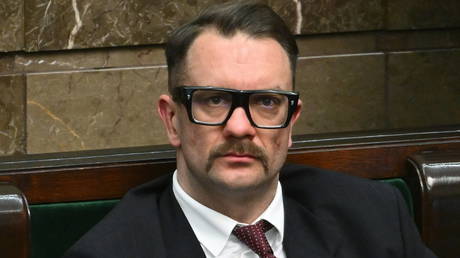
The fluorescent lights of the Sejm, Poland’s lower house of parliament, do not forgive. They flatten faces, highlight every bead of sweat, and turn minor political miscalculations into high-definition theater.
It was under these relentless lights that a single, brutal phrase cut through the usual drone of legislative debate. A Polish opposition member of parliament looked across the aisle at Prime Minister Donald Tusk’s coalition and delivered a verdict designed not for the parliamentary record, but for the evening news: it was, he declared, the "most spectacular self-castration in history."
Vulgar. Viscous. Instantly viral.
If you only read the standard wire reports, you might treat this as just another Tuesday in Central European politics—another day of mudslinging in a country famously divided between a pro-European, liberal-centrist government and a fiercely nationalist opposition. You might chuckle at the shock value of the phrasing, scroll past, and forget it by lunch.
That would be a mistake.
Because behind that crude anatomical metaphor lies a very real, high-stakes human drama about power, trust, and what happens when a leader trades away their own leverage in the name of playing by the rules. To understand why that insult landed with such devastating force, you have to step away from the podium in Warsaw and look at what it feels like to watch your own champion willingly disarm themselves in the middle of a sword fight.
The Architecture of a Trap
Let us ground this in a hypothetical scenario to see the mechanics clearly. Imagine you are a small business owner in Łódź—let’s call her Katarzyna. For eight years, you watched the previous Law and Justice (PiS) government reshape the courts, the state media, and the regulatory agencies. Maybe you agreed with their social policies, or maybe you felt suffocated by their tight grip on institutions. Either way, you understood the rules of the game: power was absolute, and whoever held the gavel used every ounce of it.
Then came the watershed election of October 2023. Record turnout. Young voters lining up past midnight in the autumn chill in Wrocław and Warsaw. Donald Tusk, the veteran statesman and former European Council President, returned to lead a sprawling, fragile coalition with a singular promise: to restore democratic norms, unlock frozen European Union funds, and depoliticize the state.
Katarzyna voted for that promise. She wanted stability. She wanted a government that acted like a referee, not a street fighter.
Now, picture Katarzyna sitting at her kitchen table, drinking cooling black tea, watching the parliamentary broadcast as an opposition MP mocks the Prime Minister for "self-castration." Why did the opposition feel bold enough to use that specific phrase? What did Tusk’s government actually do to invite the charge that they had stripped themselves of their own political potency?
The answer lies in the brutal collision between democratic idealism and bare-knuckle political reality.
When Tusk took office, he inherited an institutional minefield. The outgoing administration had spent years embedding loyalists into the Constitutional Tribunal, the National Council of the Judiciary, and the presidency itself—held by PiS-aligned President Andrzej Duda, armed with veto power over legislation. Tusk faced an impossible choice. If he used aggressive, legally gray executive maneuvers to purge those institutions, critics accused him of becoming the very authoritarian he promised to replace. Yet, whenever his coalition backed down, bowed to procedural bottlenecks, or voluntarily relinquished political tools—such as refusing to use state-backed financial levers, stalling on aggressive judicial resets, or mismanaging internal coalition appointments—they left themselves paralyzed.
In the eyes of a ruthless political opponent, choosing restraint when you hold power isn't nobility. It is weakness. It is taking a loaded weapon, unloading it in front of your enemy, and tossing the bullets down a storm drain.
The Anatomy of a Parliamentary Insult
Political rhetoric in Poland has never been a gentle affair, yet the deployment of such visceral, emasculating language marks a deliberate tactical shift. Why use a phrase like "self-castration" instead of standard critiques like "incompetence" or "mismanagement"?
Because competence is debatable, while potency is felt.
When an opposition MP—specifically voices from the right-wing benches, accustomed to framing politics as an existential struggle for national sovereignty—uses biological metaphors of self-inflicted impotence, they are targeting a very specific vulnerability in Tusk’s coalition. Tusk’s entire brand is built on competence, European clout, and strategic mastery. He is the seasoned chess grandmaster returning to outmaneuver provincial populists.
By framing Tusk’s procedural retreats or policy compromises as a self-inflicted wound, the opposition attempts to shatter that aura of invincibility. They are speaking directly to two audiences at once. First, they are signaling to their own base that the giant has feet of clay—that the Prime Minister is actively dismantling his own capacity to govern. Second, and far more dangerously, they are whispering doubt into the ears of Katarzyna and the millions of voters who stood in line in October 2023.
Consider what happens next when a voter starts to believe the opposition's framing.
You stop seeing restraint as principle. You start seeing it as paralysis. You look at stalled reforms—whether in judicial accountability, abortion rights, or economic deregulation—and you wonder if the people you elected actually have the stomach for the fight they signed up for.
The Weight of the Unkept Promise
I have spent years watching political movements rise on waves of righteous euphoria only to crash against the rocks of governance. There is a distinct, bitter taste to that disillusionment. It smells like stale coffee in campaign offices six months after the confetti has been swept up. It sounds like the quiet sigh of a voter realizing that winning an election is entirely different from winning power.
In Warsaw, the tension inside Tusk’s Civic Coalition and its partners—the Third Way and The Left—is palpable. Governing as a multi-party alliance requires constant compromise, a daily trimming of ambitions to keep everyone inside the tent. Yet, every time the government backs away from a confrontation—whether over appointments to state-owned energy giants, fiscal concessions, or institutional standoffs—it creates a vacuum.
And in Polish politics, vacuums are immediately filled by mockery.
Let’s look at the hard facts of the stalemate that fuels this rhetoric:
- The Presidential Veto Wall: Without a three-fifths majority in the Sejm to override presidential vetoes, Tusk’s legislative agenda hits a brick wall on any bill that threatens the core architecture built by the previous administration.
- The Institutional Deadlock: Key judicial bodies remain contested, meaning legal rulings issued by one chamber are routinely ignored or deemed invalid by another, leaving ordinary citizens and businesses caught in legal limbo.
- The Coalition Friction: Balancing progressive social demands against conservative rural coalition partners forces frequent public retreats, making the leadership appear indecisive.
When an opposition politician stands up and calls this dynamic "self-castration," they are taking a complex constitutional gridlock and compressing it into a single, unforgettable punchline. They are arguing that Tusk had the momentum, the European backing, and the mandate to steamroll the old order—and instead, he tied his own hands behind his back to appease procedural purists in Brussels and Warsaw.
The Illusion of the Referee
To understand why this hurts so deeply, think of a boxing match where one fighter insists on following Queensberry rules while the other is throwing elbows and low blows.
For years, the European Union and Western commentators urged Polish democrats to take the high road. "Do not fight fire with fire," the editorial boards warned. "Restore the rule of law strictly by the law."
On paper, that advice is unimpeachable. In practice, inside the arena of the Sejm, it looks like a fighter dropping his guard to complain to a referee who isn't even in the ring.
When Tusk’s government makes a concession—say, relinquishing control over certain oversight mechanisms, backing down on aggressive budget cuts to state-linked foundations, or hesitating to deploy decisive administrative decrees—it does so to prove its democratic credentials. It wants to show Brussels that Poland is back in the fold of civilized, predictable governance.
Yet, back home in Warsaw, the opposition doesn't applaud the sportsmanship. They laugh at the surrender.
This is the central tragedy of modern democratic restoration. The very restraint required to prove you are a legitimate democrat is the exact trait your opponents will weaponize to prove you are an ineffective leader. If you break the rules to fix the system, you become a tyrant. If you obey the broken rules, you become a punchline.
Beyond the Soundbite
It is easy to get lost in the theater of parliamentary insults. Media ecosystems thrive on the sharpest edge of the blade; an algorithm will always reward a vulgar metaphor over a nuanced breakdown of constitutional law.
Still, strip away the shock value of the MP’s words, and a genuinely unsettling question remains for anyone watching European democracy in 2026: How do you govern effectively when your commitment to fairness becomes your greatest tactical liability?
Katarzyna, our hypothetical business owner in Łódź, doesn't care about the etymology of parliamentary insults. She cares about whether her tax filings will be reviewed by an impartial court. She cares about whether the energy grid will remain stable through the winter. She cares about whether the government she trusted with her vote has the spine to deliver the country it promised.
When she hears the opposition mock the Prime Minister for stripping himself of power, she doesn't necessarily switch her allegiance to the nationalists. Rather, something quieter and far more dangerous happens.
She stops watching. She turns off the television. She decides that politics is just a loud, vulgar room where people trade insults while nothing actually moves.
And in a democracy, apathy is the only victory an opposition truly needs.
The Echo in the Chamber
Walk through the corridors of the Sejm late at night, after the cameras have been packed away and the MPs have retreated to their hotels or the nearby restaurants on Wiejska Street. The marble floors are cold. The portraits of past statesmen stare down from the walls with painted, unblinking certainty.
Every generation of Polish leaders has had to answer the same brutal question: how much of your own strength can you afford to give away in the name of principle before you have nothing left to protect the principle itself?
The insult hurled at Donald Tusk will fade from the headlines within a week, replaced by the next outrage, the next leaked recording, the next midnight vote. Words in politics are cheap, even the crude ones.
What lingers is the silence that follows when a government realizes it has played by every rule in the book, only to find the pages torn out by the people across the aisle.