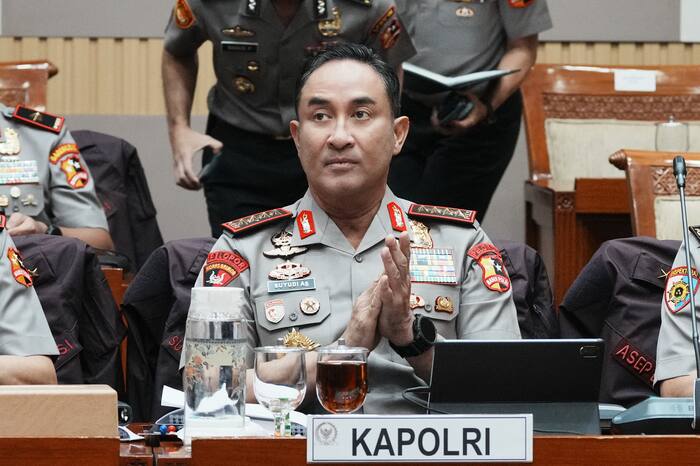
State security infrastructures rely on institutional trust, clear chains of command, and strict oversight mechanisms. When these internal controls fail, the apparatus turns inward, shifting its operational capacity from external defense and public safety toward executive surveillance and political subversion. The unfolding investigation into high-ranking members of the Indonesian National Police illustrates a systematic breakdown in intelligence governance, where clandestine communications interception targets not only the executive branch but extends across elite political networks.
The Mechanics of Institutional Capture
Intelligence gathering networks depend on resource concentration, technical access, and operational compartmentalization. In the case centered around former National Police Chief Listyo Sigit Prabowo and senior generals including Ahrie Sonta Nasution, Eko Hadi Santoso, and Slamet Uliandi, the apparatus utilized specialized communication interception capabilities originally intended for criminal investigations. Learn more on a similar subject: this related article.
The operational footprint of this network operated through clear functional layers:
- Target Acquisition: Identifying high-value political figures, prospective police leadership candidates, and personnel within the presidential circle.
- Data Interception: Executing unauthorized surveillance operations to capture electronic communications and intelligence daily updates.
- Evidence Mitigation: Attempting to destroy servers, wipe digital logs, and relocate hardware infrastructure to obscure the command chain.
By repurposing counter-terrorism and criminal investigation units for political monitoring, the architects of the operation created an internal intelligence monopoly. This bypassed traditional legislative oversight and neutralized institutional checks and balances. More journalism by Associated Press highlights comparable views on the subject.
The Cost Function of Elite De-synchronization
A security apparatus functions as an extension of executive authority. When a structural split occurs between successive administrations—specifically the legacy influence of former President Joko Widodo and the current administration of President Prabowo Subianto—the internal alignment of state institutions fractures.
The motivations driving unauthorized surveillance within security hierarchies typically stem from institutional self-preservation. Intercepting communications at the highest levels of government serves three distinct operational objectives:
- Information Asymmetry: Acquiring early intelligence regarding leadership rotations, disciplinary hearings, and policy shifts before official implementation.
- Leverage Accumulation: Storing intercepted data to deter administrative restructuring, demotions, or anti-corruption purges.
- Network Preservation: Maintaining institutional silos that protect legacy power structures against incoming administrative oversight.
The transition of power to a new administration triggers a loyalty test across the bureaucracy. Security institutions caught between competing political factions experience severe operational degradation, transforming law enforcement agencies into arenas for political friction rather than instruments of public governance.
Structural Vulnerabilities in Surveillance Governance
The expansion of illegal wiretapping beyond the executive office to encompass broader political actors exposes systemic vulnerabilities in modern state intelligence architecture.
The primary vulnerability is the centralization of technical oversight without proportional auditing. When specialized technological tools for communications interception reside entirely within operational units without independent judicial or legislative verification, the barrier to executive overreach drops significantly. Decentralized checks—such as mandatory multi-agency sign-offs or independent parliamentary auditing of interception logs—form the primary defense against internal subversion.
Furthermore, the rapid deployment of digital assets, mobile operational bases, and encrypted data storage highlights the challenge of forensic recovery in modern investigations. Security agencies possess advanced cryptographic and anti-forensic capabilities, making internal compliance monitoring exceptionally difficult once an operational unit becomes compromised.
Strategic Outlook
The legal and administrative response by current National Police Chief Suyudi Ario Seto—characterized by widespread structural rotations, internal ethics hearings, and coordination with external intelligence agencies—represents a necessary operational purge to restore command integrity. However, surface-level personnel mutations do not resolve the underlying structural deficit.
To prevent future intelligence-gathering deviations, institutional reform must decouple tactical surveillance units from direct executive command of single leadership offices. Establishing strict institutional firewalls, mandating transparent audit trails for every interception request, and subjecting specialized technical divisions to continuous legislative review are the requisite mechanical adjustments to re-establish state security reliability.