The ceiling fan spins in slow, rhythmic circles. White noise. For hours on end, white noise is the soundtrack of a body that has chosen to stop listening.
When paralysis arrives, it does not announce itself with sirens. It comes quietly, a sudden severing of the conversation between the mind and the limbs. You think about moving your hand to brush a stray hair from your forehead, and nothing happens. The command leaves the brain, races down the neural highway, and crashes into a barricade. Road closed. Detour impossible.
We talk about disability in terms of statistics. We count ramps, measure doorframes, and debate healthcare policies in sterile committee rooms. But numbers fail to capture the weight of a trapped afternoon. They miss the heavy silence of a room where the only thing moving is the sunlight shifting across the floorboards.
Consider what happens next: the world outside keeps rushing forward. Cars honk. People argue over coffee orders. Entire industries invent new ways to move faster, think quicker, and connect deeper, leaving behind an entire population tethered to stationary chairs, watching life through a pane of glass.
Huang Lei understood that silence intimately.
Years ago, an accident fractured the architecture of his life. The physical damage was absolute. Doctors used precise medical terms to describe the broken pathways, translating a human tragedy into clinical shorthand. Quadriplegia. Spinal cord transection. Permanent loss of motor function.
Yet, inside that still shell, a mind remained entirely intact. Thoughts still sparked with electricity. Memories still burned bright. Ambition did not evaporate simply because the muscles forgot how to obey.
That is the great cruel joke of physical confinement. The intellect stays wild, hungry, and curious, while the vessel refuses to cooperate.
For a long time, Huang lived within those walls. But frustration is a potent fuel. When the world tells you that your story is over, you have two choices. You can accept the quiet margins, or you can build a new bridge across the chasm.
He chose to build.
[Image of brain computer interface concept]
To understand what Huang achieved, we have to look past the shiny veneer of science fiction. For decades, popular culture fed us a specific brand of futures: sleek helmets, glowing wires, and instant mastery. Reality is infinitely messier, sweatier, and more stubborn.
The human brain is an electrical storm. Every time you blink, reach for a glass of water, or feel a surge of anger, billions of neurons fire in intricate, chaotic patterns. Translating that internal thunderstorm into a mechanical action requires an interpreter.
Enter the brain-computer interface.
Think of it like an archaeological excavation. Buried beneath the skull is a treasure trove of intent. The challenge is not creating the electricity; it is listening to the right whispers amidst the roar.
Huang partnered with brilliant minds at institutions known for turning impossible dreams into cold, hard engineering. They did not build a miracle overnight. They built prototypes that failed. They wrote code that crashed. They sat in sterile labs for thousands of hours, staring at jagged lines on computer monitors that looked like the heartbeat of a dying star.
Every failed test was a reminder of the sheer difficulty of the task. Brain waves are noisy. They shift depending on whether you are tired, anxious, or thinking about lunch. Teaching a machine to decode those subtle fluctuations is like trying to understand a symphony played entirely on a single, broken drum.
Yet, patience is a quiet virtue.
Slowly, the system began to learn Huang. Or rather, Huang and the machine learned each other. It was a strange kind of digital dance. He would sit quietly, eyes focused, imagining the sensation of movement. Not forcing it, but visualizing it with absolute clarity.
Left. Right. Forward. Stop.
In the beginning, the wheelchair stuttered. It lurched awkwardly to the left when he wanted to go straight. It hesitated, confused by the static of a tired mind. But algorithms adapt. Machine learning models chew through data, finding hidden correlations that human eyes miss.
Day after day, the translation grew sharper. The gap between thought and motion began to shrink. From seconds to milliseconds. From milliseconds to something that felt dangerously close to instinct.
Then came the day of the test.
Competitions in the world of technology often feel sterile. Fluorescent lights hum above rows of judges holding clipboards. Pitch decks flash on oversized screens, filled with corporate jargon and venture capital projections.
This was different.
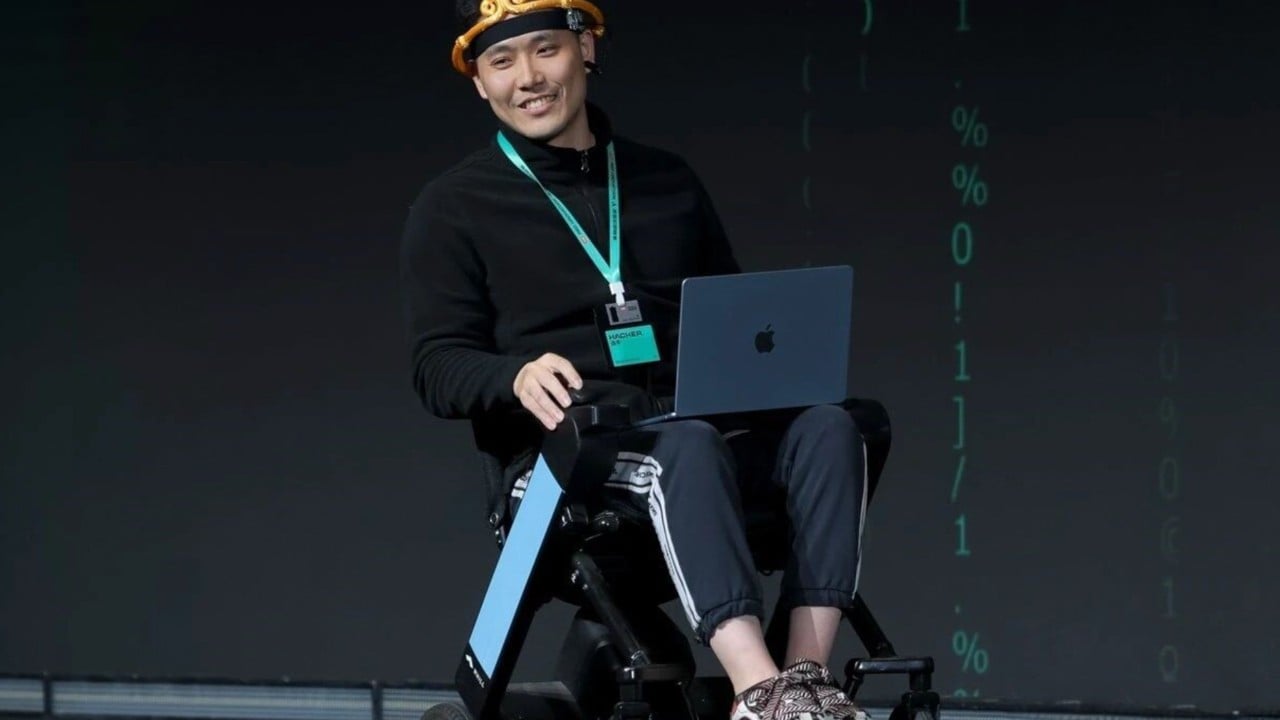
When Huang’s mind-controlled wheelchair took center stage, it did not rely on flashy marketing. It rolled forward on quiet rubber tires, propelled by nothing more than concentrated thought.
The judges watched in silence. Across the room, engineers held their breath.
Huang sat upright, his expression calm, eyes fixed on an obstacle course designed to test precision, speed, and reliability. The chair glided. It turned smoothly around a corner, paused precisely where commanded, and navigated a tight corridor without grazing a single wall.
It was not magic. It was mathematics, neuroscience, and stubborn human refusal wrapped in metal and circuitry.
When the results were tallied, the announcement echoed through the hall. First place. Top prize. Applause erupted, loud and sustained.
Cameras flashed. Microphones thrust forward. Reporters asked predictable questions about commercial viability, market size, and patent timelines. They wanted to turn a human triumph into a business case.
They missed the point entirely.
The trophy sitting on the table was shiny, but it was just a byproduct. The real victory was written in the geometry of movement.
For someone who has spent years waiting for permission to cross a room, mobility is not a convenience. It is dignity. It is the ability to turn around and look someone in the eye instead of staring at their belt loops. It is the sudden, terrifying, wonderful rush of autonomy.
We live in an era obsessed with artificial intelligence that writes poems and generates images. We marvel at machines that can mimic human art. Yet, we sometimes overlook the technology that heals the fractures in our own humanity.
Technology is rarely neutral. It either widens the chasm or builds the bridge. When applied with empathy, it stops being a collection of microchips and starts becoming an extension of the soul.
Huang’s wheelchair is not the end of the journey. It is a proof of concept for a much larger truth. The human spirit, when cornered by limitation, does not simply surrender. It reinvents the rules of engagement.
The ceiling fan still spins in quiet rooms around the world. White noise still fills the hours for those waiting for a breakthrough. But somewhere in a laboratory, another mind is dreaming up a way to break the silence.
The barriers are real. The physics are unforgiving. But the blueprint has changed.
Motion is no longer the exclusive privilege of the uninjured. It belongs to anyone brave enough to imagine it, one electrical spark at a time.