A total failure of an energy grid does not happen all at once. It occurs in a series of micro-collapses, a rhythmic cadence of failing metal, dry pipelines, and desperate improvisations. Across Cuba, the national grid has transformed from an invisible infrastructure into a daily, brutal negotiator of survival. When the Antonio Guiteras thermal plant in Matanzas trips due to a boiler leak, or when the Nuevitas plant in Camagüey experiences an unexpected failure, the resulting cascade can plunge the entire island into silence for thirty hours at a time. This is no longer an occasional inconvenience. It is a structural unraveling where the state cannot meet even half of the national peak electricity demand, leaving millions without power for eighteen hours or more each day.
The immediate reaction of observers is to view the crisis through a binary lens of low-tech and high-tech adaptations. Media reports fixate on the paradox of a population caught between homemade charcoal burners and imported solar infrastructure. But this dichotomy obscures the deeper systemic mechanics at play. The real story of Cuba's energy emergency is not just that people are burning wood to cook beans, or that private businesses are buying solar panels. The true narrative lies in the sudden, aggressive geopolitics of oil supply, the irreversible structural fatigue of Cold War-era machinery, and an unprecedented, state-sanctioned solar scramble financed by Beijing to build an emergency energy baseline before the domestic grid permanently breaks apart.
The Mathematics of the Deficit
To understand the scale of the failure, one must look at the generation data. During evening peak hours, Cuba’s National Electric System requires approximately 3,000 megawatts to keep the lights on, the water pumps running, and the domestic refrigerators cold. Actual generation frequently hovers at just 1,200 to 1,300 megawatts. This leaves a massive daily deficit of over 1,700 megawatts.
This gap cannot be closed by simple conservation measures. The island's sixteen primary thermoelectric units were constructed with an operational design life of roughly 100,000 hours. Most have blown past that milestone by decades. Deprived of capital for deep overhauls, these plants run at an average of just 34 percent of their rated capacity. They are kept online through MacGyver-style maintenance, cannibalizing parts from decommissioned units to patch active boilers. When a single pipe bursts in one of these ancient systems, the sudden drop in frequency destabilizes the rest of the fragile network, causing a total grid disconnection.
The structural decay is compounded by an acute fuel starvation. Cuba produces less than 40 percent of the oil it requires to power its domestic economy. For years, the shortfall was covered by heavily discounted Venezuelan crude and occasional shipments from Mexico. That lifeline fractured following a dramatic escalation of external pressure. A strict energy blockade, driven by aggressive U.S. sanctions and threats of retaliatory tariffs on shipping fleets, caused Venezuelan oil imports to drop to nearly zero. The impact was immediate. Without fuel to feed the operational thermal plants or the distributed diesel generation sets that dot the provinces, the system entered a state of permanent rolling blackouts.
The Charcoal Economy and the Class Divide
When the electricity vanishes for days, domestic life shifts outside to the dirt yards and the balconies. Cooking in Cuba has long been electrified, a legacy of the energy revolution initiated in the early 2000s that replaced kerosene stoves with Chinese-made electric burners and rice cookers. That policy has now backfired spectacularly. Without electricity, and with liquefied petroleum gas severely rationed, the population has been forced to regress.
Domestic Energy Stratification in the Crisis
+-----------------------+-----------------------------------+-----------------------------------+
| Economic Tier         | Primary Cooking Method            | Emergency Power Source            |
+-----------------------+-----------------------------------+-----------------------------------+
| State Salary Earners  | Homemade Charcoal Stoves          | None / Discharged Flashlights     |
| Remittance Receivers  | LPG / Premium Charcoal            | Small Lithium Power Banks         |
| Private Business Owner| Induction / Imported Gas          | Rooftop Solar / Grid-Tied Inverter|
+-----------------------+-----------------------------------+-----------------------------------+
The surge in demand has created a lucrative, informal market for charcoal. On the fringes of Havana and in provincial towns, blacksmiths fashion rudimentary braziers out of discarded washing machine drums and scrap metal sheet, selling them for the equivalent of a full month’s state salary. A single sack of charcoal can cost upwards of 2,600 pesos. For a population where the average state wage hovers around 5,000 pesos, the math of basic nutrition is ruinous. Families must choose between buying the food itself or buying the fuel required to cook it.
This reliance on wood fuel has triggered significant domestic micro-economies, but it has also exposed a stark domestic stratification.
- The Underclass: Dependent on state salaries, burning scrap wood or low-grade charcoal in unvented spaces, facing immediate respiratory risks.
- The Remittance Class: Cubans with relatives abroad who can receive cash via informal channels, allowing them to purchase premium charcoal or scarce cylinders of liquid gas on the black market.
- The New Entrepreneurs: Owners of newly legalized small and medium-sized private enterprises (Mipymes) who possess the capital to bypass the failing state grid entirely.
The Private Solar Escape Hatch
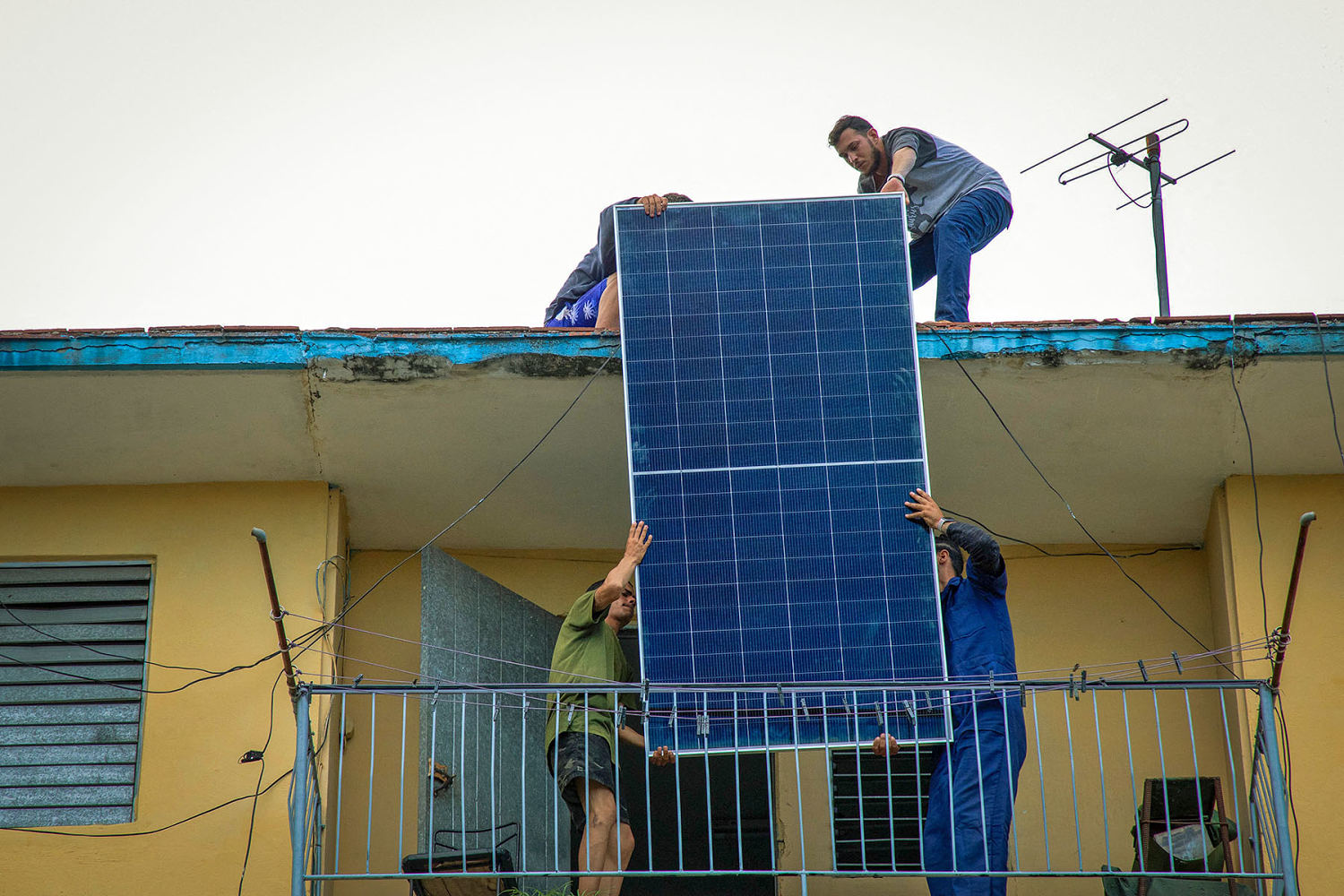
While the state sector suffocates under fuel shortages, a parallel energy architecture is emerging in the private sector. The Cuban government, desperate to relieve pressure on the national grid, eliminated import tariffs on solar panels, lithium batteries, and inverter systems for individuals. This regulatory opening triggered an influx of hardware, mostly shipped by family members in Miami or imported directly by private entities through Panama and Guyana.
In the wealthier neighborhoods of Havana, such as Vedado and Miramar, rooftops are increasingly lined with photovoltaic arrays. Private installation firms work around the clock, anchoring panels to concrete roofs to withstand the Caribbean hurricane season. These systems are not tied into the grid to sell power back; they are configured as islanded micro-systems designed to keep deep freezers running, air conditioners humming, and electric motorcycles charged.
http://googleusercontent.com/image_content/235
This private solar boom keeps vital businesses alive, but it does nothing to rescue the wider public infrastructure. The Catholic Church, utilizing foreign donations, has installed solar systems on nursing homes and community kitchens to prevent food spoilage. Yet for the vast majority of the population, the cost of a modest 1-kilowatt solar setup—running into thousands of U.S. dollars—is an astronomical impossibility. The energy crisis is actively codifying a new social hierarchy: those who own the sun, and those who sit in the dark.
The Geopolitical Solar Transition
The state’s long-term strategy acknowledges that the thermal plants are dying. It is impossible to rebuild them under the current economic restrictions. Instead, the administration has pivoted toward an aggressive, centralized renewable energy push, executed almost entirely with Chinese capital, engineering, and equipment.
The scope of this initiative is massive. The national target demands the installation of 92 utility-scale solar parks by 2028, aimed at bringing 2,000 megawatts of clean capacity online. According to recent industrial data, more than 50 of these parks are already active, pushing renewable generation from a meager 3 percent in 2024 to roughly 10 percent of the national mix. China's direct export of solar hardware to the island surged from just $3 million in 2023 to an estimated $117 million.
Cuba State Solar Infrastructure Goals (2024–2028)
- Target Number of Solar Parks: 92
- Total Planned Capacity: 2,000 Megawatts
- Active Parks (Mid-2026): ~50
- Current Renewable Share: ~10%
- Estimated Total Infrastructure Cost for Self-Sufficiency: $8 Billion
This rapid construction program is unique in its velocity, but it faces an architectural bottleneck: the lack of grid-scale energy storage. Solar power is highly effective at clipping the midday demand peak, but it drops off precisely when the island encounters its most severe stress—the evening peak between 6:00 PM and 10:00 PM, when millions of households turn on lights and fan units.
To bridge this gap, independent energy analysts estimate that Cuba would need to invest roughly $8 billion in a synchronized solar-and-battery infrastructure to eliminate its dependence on foreign fuel for electricity generation. Reaching a fully stable, 100 percent renewable system would require close to $19 billion. In an economy burdened by debt, hyperinflation, and a decimated tourism sector, finding that capital requires a level of sovereign concession that few international lenders outside of Beijing are willing to entertain.
The Grid as a Tool of Attrition
The geopolitical realities shaping this crisis cannot be ignored. The strict U.S. embargo acts as an environmental amplifier, preventing Cuba from buying standard replacement parts from international markets, forcing them to pay premium transport fees for every barrel of non-sanctioned oil, and discouraging European clean-energy conglomerates from investing due to the threat of secondary sanctions. The policy intent is clear: use infrastructure starvation to trigger political change.
But the domestic outcome is not a sudden political transition; it is a steady, grinding attrition of civilian life. The lack of reliable power has crippled water pumping stations, leaving entire municipalities dependent on erratic water truck deliveries. Hospitals operate under the shadow of sudden generator failures, where surgical teams must calculate whether an aging diesel unit has enough fuel to survive a complex procedure. Food distribution systems are broken because state refrigeration facilities cannot maintain the cold chain, leading to the spoilage of tons of scarce agricultural produce before it can reach consumers.
The resulting social pressure has accelerated a massive demographic shift. The island has lost over ten percent of its population since the pandemic era, an exodus of younger, skilled professionals, including engineers, electricians, and technicians who possess the exact skills required to maintain a failing power grid. Every engineer who leaves for Miami or Madrid increases the operational strain on the skeleton crews left behind in the control rooms of Matanzas and Cienfuegos.
The Cuban energy crisis is not a temporary phase of scarcity that can be waited out. It is a permanent structural shift. The old model of large, centralized, oil-burning thermal plants connected to an overextended national grid is functionally dead, killed by age and a lack of fuel. The future of the island will be dictated by how fast it can decentralize its generation capacity. Whether that transformation occurs via chaotic, unequal private solar acquisition and backyard charcoal pits, or through a massive, Chinese-financed state transition to utility-scale renewables, will determine whether the island can keep its lights on or plunge permanently into a pre-industrial twilight.