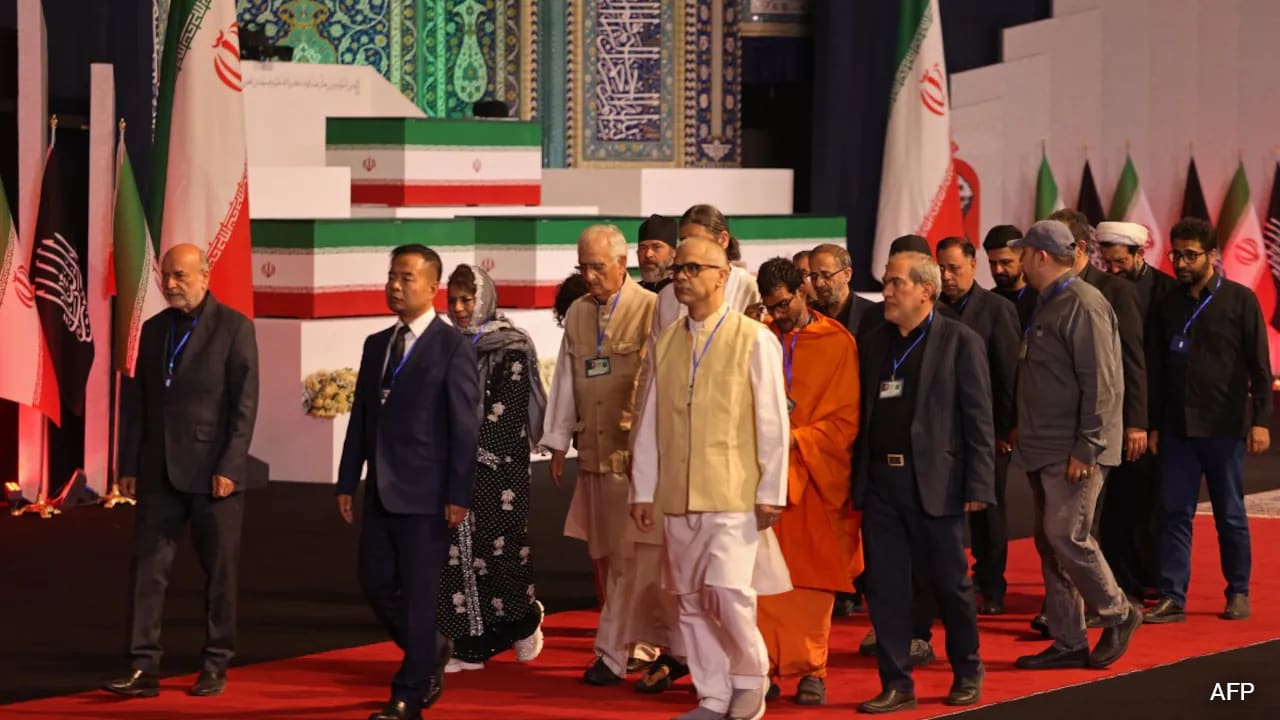
The public message of appreciation issued by the Iranian Embassy in New Delhi to the Indian government following the state funeral of Ayatollah Ali Khamenei is not a standard diplomatic courtesy. It represents a calculated signal within a complex regional ecosystem. Tehran’s formal acknowledgment of India’s high-level delegation—which included Minister of State for External Affairs Pabitra Margherita and Bihar Governor Lieutenant General (Retired) Syed Ata Hasnain—highlights a structural dependency that survives severe geopolitical friction. For analysts tracking West Asian dynamics, this interaction offers raw data on how revisionist states manage isolation by maintaining critical ties with neutral, multi-aligned powers.
Understanding this dynamic requires moving past empty statements about shared history and analyzing the strategic utility each nation derives from the relationship. This analysis deconstructs the structural variables driving Iran's diplomatic signaling, the mechanics of India's strategic autonomy, and the underlying economic architecture that keeps New Delhi and Tehran aligned despite heavy pressure from the West.
The Strategic Architecture of Iranian Outreach
Tehran operates under a highly constrained diplomatic framework. Following the February 2026 strikes that resulted in the death of the Supreme Leader, the Islamic Republic faced sudden internal instability during its political transition to Mojtaba Khamenei, combined with intense external military pressure from a coalition led by the United States and Israel. In this environment, diplomatic interactions serve a clear purpose: validating the state's legitimacy and showing domestic and international audiences that the regime is not isolated.
The diplomatic outreach can be broken down into three distinct operational goals:
- International Legitimacy Validation: By inviting approximately 100 nations to the funeral ceremonies, Tehran sought to prove its state machinery remains fully functional. The presence of official delegations from major democratic powers like India undercuts Western attempts to frame Iran as an isolated state.
- Domestic Stability Signaling: For the internal audience in Iran, massive public events paired with international recognition help stabilize the regime. Showing images of foreign dignitaries paying respects at the Imam Khomeini Grand Mosalla helps calm domestic markets and signals that the state transition has international backing.
- Strategic Deterrence: When a nation facing active conflict hosts diverse global representatives—ranging from regional proxy groups to major global economies—it creates an informal diplomatic shield. It signals to adversaries that large-scale military actions against Tehran carry international diplomatic costs.
The decision to single out India with explicit praise on public channels acts as a targeted message. It recognizes New Delhi's willingness to resist Western pressure and continue its state-to-state engagements with Iran.
The Indian Multi-Vector Diplomatic Equation
India’s decision to send a high-level delegation to Tehran during a period of active regional conflict reflects its long-standing commitment to strategic autonomy. New Delhi routinely rejects binary alliances, preferring a multi-vector foreign policy designed to maximize its national security and economic interests across different regions.
This approach balances two distinct, conflicting priorities:
The Western Strategic Partnership
New Delhi maintains deep defense, technology, and economic ties with the United States and is a key member of the Quadrilateral Security Dialogue (Quad). At the same time, India has built a strong strategic partnership with Israel, particularly in defense procurement and counter-terrorism intelligence. Attending a state funeral where crowds chanted slogans against Washington and Tel Aviv shows that India is determined to separate its bilateral ties with Western partners from its independent relationship with Iran.
The Eurasian and West Asian Balance
India views Iran as a crucial geographic gateway to Central Asia and the broader Eurasian continent. Maintaining a stable relationship with Tehran is essential for India to counter Pakistan’s land-blocking strategy and balance China’s growing footprint in the region, particularly its investments in the Gwadar port.
The composition of the Indian delegation reflects a deliberate attempt to manage domestic political dynamics while fulfilling international goals. Sending a diverse group—including senior government figures, opposition leaders like Salman Khurshid and Mehbooba Mufti, and representatives from various religious communities—allows New Delhi to show a broad national consensus on its relationship with Iran. This helps protect the decision from partisan domestic criticism while honoring its diplomatic ties with Tehran.
Economic Underpinnings and Transit Corridors
The real strength of the India-Iran relationship lies in geography and long-term infrastructure investments rather than shared ideological goals. The core of this economic relationship revolves around a major infrastructure project: the Chabahar Port.
[India] --(Sea Lanes)--> [Chabahar Port (Iran)] --(Zahedan Railway)--> [Central Asia / Russia]
The strategic value of Chabahar can be broken down into three main structural benefits:
- Bypassing Overland Bottlenecks: Pakistan’s refusal to grant India overland transit access to Afghanistan and Central Asia created a major logistical bottleneck for New Delhi. Chabahar provides a direct sea-to-land route that allows India to completely bypass Pakistani territory.
- The International North-South Transport Corridor (INSTC): Chabahar is the maritime anchor for the INSTC, a 7,200-kilometer multi-mode transportation network designed to move freight between India, Iran, Azerbaijan, and Russia. This route reduces transit times by nearly 40% and lowers freight costs by 30% compared to the traditional sea route through the Suez Canal.
- Countering the Belt and Road Initiative: Located just 170 kilometers away from China’s Beijing-funded Gwadar port in Pakistan, Chabahar gives India a critical strategic position near the Strait of Hormuz, a vital chokepoint through which one-fifth of the world’s crude oil passes.
India’s long-term management lease for the Shahid Beheshti terminal at Chabahar Port underscores its commitment to this infrastructure corridor. For Iran, Indian investment provides a steady stream of capital and technical expertise that cannot be easily shut down by Western sanctions. This economic link creates a structural floor for the relationship; regardless of leadership changes or shifting political rhetoric in either Tehran or New Delhi, both nations have a strong interest in keeping this transit corridor open.
Structural Bottlenecks and Relationship Hard Limits
While the public exchange of gratitude points to a resilient partnership, the relationship faces clear structural limitations. These constraints prevent India and Iran from building a full strategic or military alliance.
The primary limitation is the impact of secondary economic sanctions imposed by the United States. Following the re-imposition of severe sanctions on Iran's energy sector, India was forced to completely halt its imports of Iranian crude oil, which previously made up over 10% of its total energy imports. New Delhi successfully replaced these volumes by importing more Russian crude oil and increasing supply from Gulf cooperation countries like Saudi Arabia and the United Arab Emirates. This shift proves that while India values its relationship with Iran, it will not sacrifice its integration into the global financial system or risk losing access to Western markets to protect its trade with Tehran.
The second bottleneck stems from the diverging priorities of each country's partners. Iran’s growing military and strategic alignment with China and Russia creates friction with India’s long-term security goals. Beijing’s 25-year strategic cooperation agreement with Iran introduces Chinese capital and intelligence capabilities into areas that sit right next to India's planned transit routes. As Iran integrates more deeply into an anti-Western bloc alongside China, India must carefully manage its involvement to ensure its presence in Chabahar does not accidentally expose its own technologies or supply chains to Chinese state surveillance.
Strategic Recommendation
The shifting balance of power in West Asia requires New Delhi to adjust its approach toward Tehran. India should move away from broad, generalized engagement and focus instead on precise, project-specific cooperation.
First, India should insulate its work on the Chabahar Port from broader geopolitical tensions by routing all investments through specialized, single-purpose corporate entities. This structure protects larger Indian financial firms from being hit by secondary Western sanctions.
Second, New Delhi should use its position as a neutral intermediary to keep communication channels open between Tehran and Western capitals. As Iran navigates a sensitive leadership transition amid ongoing regional conflicts, India's proven ability to balance ties with competing powers makes it a reliable diplomatic bridge. This positioning protects India’s long-term transport routes into Central Asia while enhancing its reputation as a stabilizing force in an increasingly polarized global environment.