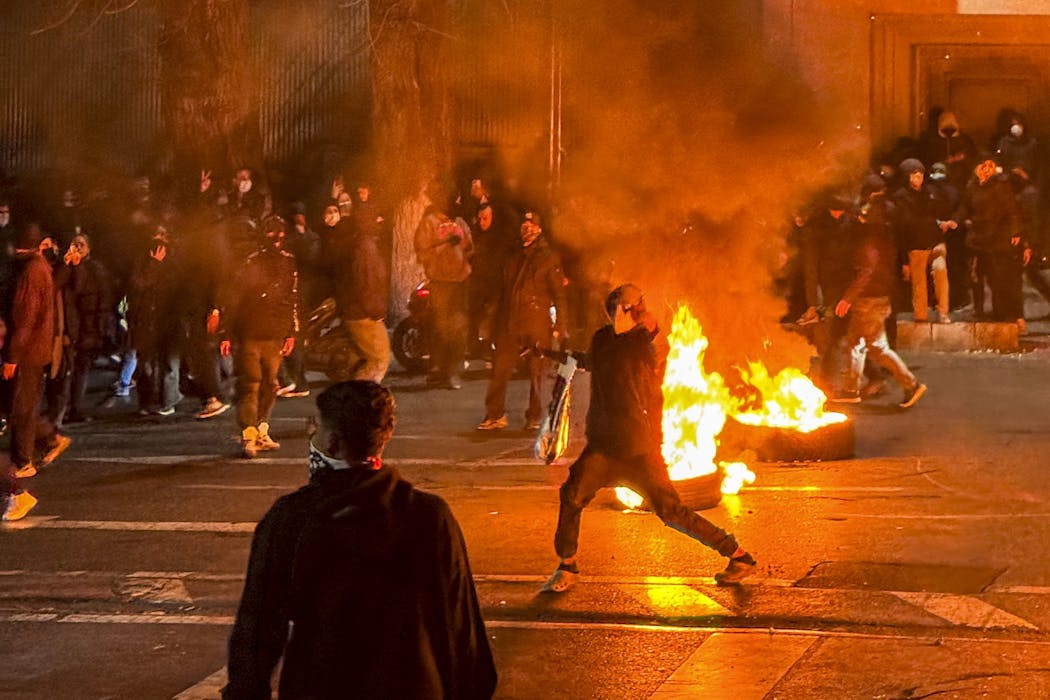
The sun sets over Tehran not with a bang, but with a flickering screen. In a small apartment in the Ekbatan district, a young woman named Roya—this is a composite name for a very real person—reaches for her phone. She wants to send a video of the afternoon’s gathering to her cousin in Berlin. She taps the upload button. The progress bar crawls to three percent and dies.
She toggles her VPN. Nothing. She restarts her router. Still nothing.
This is the first stage of the playbook, and it is the most intimate form of isolation. By the time the sun is fully down, the "Filternet" has tightened its grip. The state has not just turned off the internet; they have severed the digital nervous system of a nation. This isn't a technical glitch. it is a calculated act of psychological warfare designed to make every citizen feel like they are standing alone in a dark room.
The Architecture of the Digital Cage
The Iranian regime does not rely on blunt force alone. They have spent a decade building a sophisticated, two-tiered reality called the National Information Network (NIN). Think of it as a massive, walled garden where the government controls the soil, the water, and the air. When the streets get too loud, they simply close the gate to the outside world.
Inside the NIN, state-approved apps for banking and messaging still hum along. This is the bait. If you want to pay your electric bill or message your mother, you must use the "halal" internet. But the moment you try to reach Instagram, WhatsApp, or any site where the truth might leak in from the outside, the connection hits a brick wall.
For the authorities, this serves a dual purpose. It keeps the economy from collapsing entirely during a crackdown, and it forces the population into a monitored digital space. Every message sent on a local app is a data point. Every "like" is a fingerprint. When the regime decides to hunt, they don't need to kick down every door; they just need to check the logs.
The Men in the Shadow of the Sun
Physical intimidation starts long before the first canister of tear gas is fired. It begins with the Basij. These are not professional soldiers in crisp uniforms. They are often young men from the provinces, dressed in civilian clothes or mismatched fatigues, riding on the back of motorbikes in packs of fifty.
The sound is what stays with you.
The high-pitched whine of two-stroke engines echoing off the concrete apartment blocks is a sensory signal. It says: We are everywhere, and we are not bound by the rules of a formal army. They carry batons, paintballs, and sometimes more lethal tools. Their job is not to win a tactical battle, but to shatter the "psychological security" of the crowd.
Consider the "identify and isolate" tactic. Security forces often use high-resolution cameras—many imported from countries with advanced surveillance industries—to map the faces of those in the front lines. They don't always arrest you on the street. Sometimes, they wait. They wait until you are back in the perceived safety of your home, and then the phone rings. Or the door is kicked in at 3:00 AM.
This delayed retribution is a cancer for a movement. It breeds a specific, paralyzing paranoia. You look at the person standing next to you in the square and wonder: Are they a plant? Is that drone overhead looking at me?
The Script of the Forced Confession
When the arrests happen, the playbook moves from the street to the studio. Within forty-eight hours of a major protest, the state television channels usually air "documentaries." These are slickly produced segments featuring young men and women with blurred faces or shadowed eyes, speaking in monotone voices.
The script is always the same. They claim they were paid by foreign intelligence agencies. They say they were tricked by social media. They express deep regret for "disturbing the public order."
To an outside observer, these videos look clumsy and coerced. But the audience isn't the international community. The audience is the grey middle—the millions of Iranians who are sympathetic to the protesters but terrified of chaos. The regime wants to frame the choice not as "Freedom vs. Tyranny," but as "Stability vs. Syria-style Collapse." By painting every protester as a tool of a foreign power, they attempt to strip the movement of its organic, human soul.
Why the Old Tricks are Faltering
History is a heavy weight, but it isn't a fixed one. In previous years—2009, 2017, 2019—the playbook worked because the gaps between generations were wide. The elders remembered the 1979 revolution and feared another one; the youth were disconnected.
But something shifted recently.
The current movement, sparked by the death of Mahsa Amini, bypassed the traditional political roadblocks. This wasn't about a disputed election or a hike in gas prices. It was about the fundamental right to exist without the state's hand on your shoulder.
When the regime tried to shut down the internet this time, the "Z-generation" of Iran was ready. They had spent years learning how to bypass filters. They used mesh networks. They shared offline maps. They turned the regime’s digital cage into a game of cat and mouse where the cat was increasingly out of its depth.
The brutality, too, has hit a point of diminishing returns. There is a psychological concept called "fear fatigue." When a population is threatened constantly for forty years, the threat eventually loses its edge. When you have nothing left to lose, the man with the baton becomes just a man.
The Invisible Stakes of the Long Game
We often talk about these events in terms of "regime change" or "geopolitics." But those are cold, abstract words. The real stakes are found in the quiet moments between the chaos.
They are found in the father who buys his daughter a new headscarf but doesn't say a word when she leaves the house with it draped around her shoulders. They are found in the shopkeeper who lowers his shutters halfway to let protesters hide from a patrol. They are found in the doctors who treat wounded demonstrators in secret basements, knowing they face a prison sentence if they are caught.
The regime’s playbook is designed to produce a specific result: atomization. They want every Iranian to feel like a lone island, surrounded by a sea of informants and enemies.
But the narrative of the last few years suggests the islands are connecting beneath the surface. The bridges are made of shared grief and a stubborn, quiet defiance that no amount of bandwidth throttling can erase.
The regime can control the speed of the internet. They can control the movement of motorbikes through the streets. They can even control the words spoken in a televised confession. But they cannot control the internal architecture of a person who has decided they are no longer afraid.
Roya eventually gives up on the video. She puts her phone in a lead-lined bag—a trick she learned on a Telegram channel before the blackout. She walks to her window and looks out over the city. It is dark, and the internet is dead, but from the balcony across the street, someone starts to shout a single, rhythmic phrase into the night. Then another voice joins from the floor above. Then another.
The bar on the screen didn't move, but the message was delivered anyway.
Would you like me to analyze the specific technological tools being used by both sides in this digital arms race?