Coastal exposure to gelatinous zooplankton in British waters generates a predictable behavioral panic every summer season, driven almost entirely by media amplification of localized envenomation incidents rather than any structural escalation in ecological risk. Assessing the true hazard profile requires stripping away anecdotal panic to examine the operational mechanics of marine stinging cells, regional oceanographic transport systems, and human recreational interface patterns.
British coastal zones host a stable baseline of cnidarian species. The hazard they present is not a function of malicious biological intent or sudden population explosions, but rather a predictable intersection of hydrographic forces and human thermal preferences. To understand the actual exposure level, one must map the vector mechanics of how these organisms reach swimmer density zones, evaluate the physiological cost function of their nematocysts, and calculate the true statistical probability of severe medical intervention.
The Hydrographic Delivery Mechanism
Gelatinous zooplankton lack active propulsion systems capable of fighting regional tidal streams or coastal currents. Their spatial distribution is a direct output of Lagrangian transport. Wind stress, Ekman transport, and thermohaline circulation dictate where aggregations accumulate.
When onshore winds persist across the North Sea or the Western Approaches, surface currents compress floating biomass against shallow shelving beaches. This creates localized concentration anomalies. Swimmers frequently misinterpret these events as population plagues. In reality, the total population of the water column may remain constant while hydrodynamic convergence zones concentrate individuals into specific bathing areas.
Water temperature operates as the primary temporal variable. As coastal waters warm during peak summer months, metabolic rates increase, prompting reproduction cycles that culminate in visible medusa phases. However, thermal stratification also changes bathymetric mixing. Strong thermoclines trap pelagic organisms in surface layers where human water contact is highest.
Taxonomic Risk Stratification
Not all medusae present an equivalent physiological threat. Evaluating risk requires a strict taxonomic breakdown of the species inhabiting UK coastal waters.
Rhizostoma pulmo
Commonly known as the barrel jellyfish, this species represents the largest native UK form. Despite an imposing physical mass, its oral arms lack potent toxins designed for rapid vertebrate subjugation. The nematocysts struggle to penetrate human stratum corneum on most parts of the body. Contact typically results in mild mechanical friction or minor localized erythema comparable to a mild nettle sting. The biological function of its venom targets small crustacean prey, rendering it largely benign to human physiological systems.
Cyanea capillata
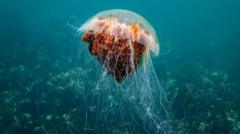
The lion's mane jellyfish operates via an entirely different biological cost function. Equipped with thousands of fine, contractile marginal tentacles containing potent proteinaceous toxins, this species utilizes neurotoxins and dermatotoxins designed for rapid immobilization of fish. In British waters, specimens found near northern latitudes can span significant diameters, though southern variants are generally smaller. Contact triggers immediate, intense localized pain, distinct linear urtication, and in systemic worst-case scenarios, localized tissue necrosis or secondary immunological responses.
Chrysaora hysoscella
The compass jellyfish occupies the middle tier of the hazard spectrum. Its V-shaped brown markings are easily identifiable, and its marginal tentacles deliver a sharp, localized burning sensation. While rarely life-threatening outside of rare anaphylactic events, the dermatological footprint remains active long after initial contact if residual tentacle fragments are left on the epidermis.
Pelagia noctiluca
Though historically rarer in UK waters, warming sea surface temperatures have increased sightings of the mauve stinger along western and southwestern approaches. This species possesses high-density battery cells across both its umbrella and tentacles. Even dead or stranded specimens washed up on shingle can fire nematocysts upon tactile stimulus due to osmotic pressure differentials.
The Physiological Cost Function of Envenomation
When human skin interfaces with a cnidarian tentacle, a mechanical and chemical trigger mechanism activates the nematocyst. This specialized cellular organelle fires at extreme acceleration, injecting a complex cocktail of enzymes, peptides, and pore-forming toxins directly into the dermal layer.
The resulting clinical presentation breaks down into three distinct phases:
- Immediate cutaneous pain resulting from ion channel disruption and localized depolarization of sensory nerve endings.
- Delayed inflammatory cascade characterized by mast cell degranulation, histamine release, and subsequent vasodilation leading to wheal-and-flare reactions.
- Systemic manifestation, which occurs in an infinitesimal fraction of cases, driven by hypersensitivity or massive toxic load from multiple envenomations over a large body surface area.
Public perception consistently overestimates the necessity of emergency medical intervention for routine stings. Standard first-aid protocols rely on interrupting the nematocyst firing sequence rather than compounding it. The application of fresh water, urine, or friction causes unfired nematocytes residing on residual tentacle material to discharge their full venom payload. Neutralization requires the application of baseline saline solutions to stabilize osmotic pressure, followed by physical removal of tentacle matter using rigid barriers rather than bare hands. Thermal application via immersion in water heated to forty-five degrees Celsius denatures heat-labile protein toxins and provides rapid analgesia by overwhelming thermal nociceptors.
Behavioral Exposure Vectors
The probability of adverse human-jellyfish interaction is governed by distinct behavioral and environmental variables rather than random chance.
[Thermal Anomaly] ---> [Increased Beach Attendance] ---> [Higher Bathymetric Overlap]
                                                                  |
[Onshore Wind Stress] -> [Hydrodynamic Convergence] ---> [Elevated Encounter Rate]
When atmospheric temperatures spike, beach attendance surges non-linearly. This behavioral shift increases the total hours of human immersion in coastal waters. Simultaneously, onshore winds drive floating biomass toward those exact same shallow recreational zones. The intersection of these two independent variables creates a statistical peak in reported stings, even if the absolute density of the marine population has not changed.
Geographic morphology further dictates exposure. Enclosed bays with restricted tidal flushing retain concentrated biological matter longer than high-energy, exposed headlands subject to rapid water exchange. Swimmers operating in sheltered estuaries or shallow sandy basins face higher localized encounter probabilities during wind-driven convergence events.
Evaluating Long-Term Environmental Shifts
Marine ecological models indicate that coastal warming trends, eutrophication from agricultural runoff, and the systemic overfishing of pelagic predators alter the baseline stability of gelatinous populations. Predatory fish and marine turtles compete with or consume medusae in early life stages. The removal of these apex constraints reduces natural mortality within the zooplankton cohort.
However, attributing every seasonal swarm to anthropogenic climate degradation oversimplifies complex multiannual population cycles. Jellyfish populations naturally experience dramatic boom-and-bust dynamics driven by prey availability and winter survival rates of benthic polyps. The transition from polyp to medusa is an environmentally gated biological switch, sensitive to subtle shifts in photoperiod and chemical cues.
Mitigating personal risk requires abandoning generalized fear in favor of operational awareness. Check local wind direction and tidal state prior to entering the water. Inspect the tideline for stranded fragments before immersion. Equip beach bags with vinegar or instant heat packs rather than relying on folklore remedies. The British coastline remains an exceptionally safe marine environment; managing the gelatinous inhabitants requires understanding their physical transport rules and physiological limitations, replacing panic with structural calculation.