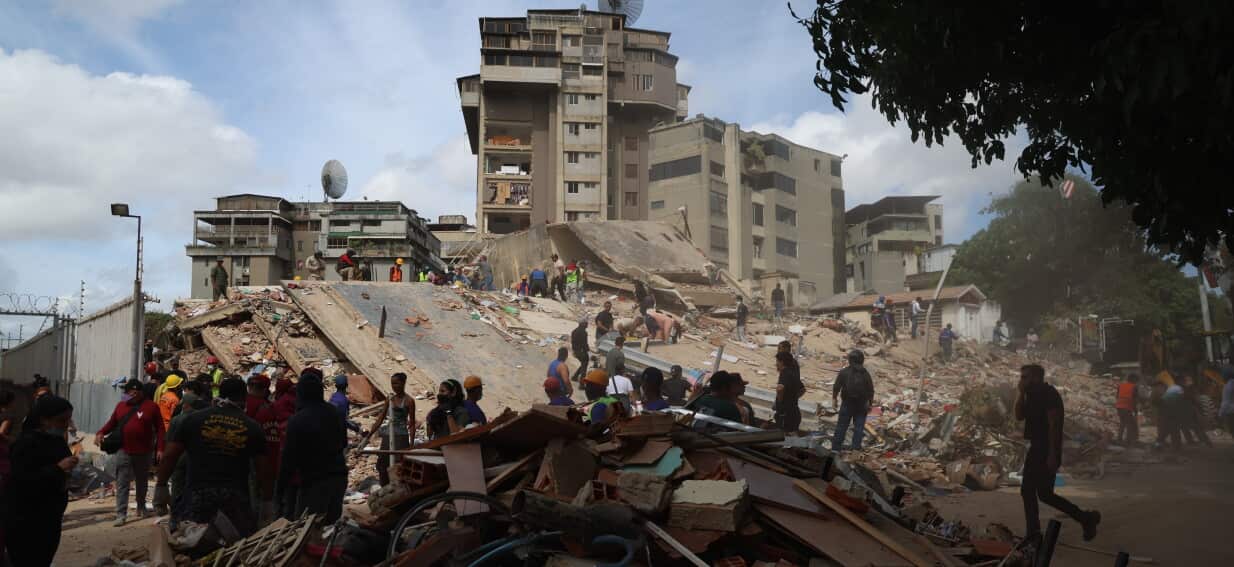
Hundreds of citizens remain trapped beneath collapsed concrete and twisted steel following the two powerful earthquakes that struck north-central Venezuela yesterday. While state media channels attribute the high casualty count entirely to a cruel twist of tectonic fate, the scale of this disaster is fundamentally a human creation. Decades of ignored building codes, unregulated construction booms, and a chronic lack of municipal oversight have transformed the nation's urban centers into structural traps. The seismic activity merely exposed a vulnerability that engineers and urban planners have warned about for a generation.
Rescue teams in cities like Maracay and Valencia are working against a ticking clock, digging through debris with inadequate heavy machinery and limited thermal imaging equipment. Local hospitals, already struggling under long-standing resource constraints, are overwhelmed by the influx of trauma patients. The official narrative focuses on the unpredictable fury of nature, but the structural evidence tells a far simpler story. Buildings collapsed not because the earth shook, but because they were never built to withstand a shake in the first place.
The Engineering Failures That Sealed the Fate of Thousands
Earthquakes kill, but faulty engineering kills faster. The twin tremors, registering back-to-back magnitudes of 6.2 and 5.9, struck an area characterized by a dangerous mix of fragile informal housing and poorly maintained mid-rise apartments. In the structural engineering community, a well-known vulnerability called the soft-story defect is often the primary culprit in urban collapses. This occurs when a building features a ground floor with large, open spaces—such as parking garages or retail storefronts—supported by thin concrete columns, while the upper floors are dense with heavy masonry walls.
During seismic rolling, the rigid upper floors move as a single block, concentrating all the lateral force onto the weak ground-floor pillars. They snap. The entire building drops straight down, pancaking the lower levels and trapping everyone inside.
Initial reports from the hardest-hit neighborhoods show a systemic failure of these exact structures. Compounding this design flaw is the widespread use of substandard building materials. Concrete requires a precise ratio of cement, clean sand, and aggregate water to achieve its rated load-bearing capacity. When developers cut corners by using unwashed beach sand—which contains corrosive salt—or by stretching cement thin with excess water, the resulting material lacks tensile strength. Over years of exposure to tropical humidity, the internal steel rebar rusts and expands, cracking the concrete from the inside out long before a fault line ever ruptures.
The Informal Housing Trap
Away from the commercial strips, the hillside barrios present an even more severe logistical and structural nightmare. More than half of the population in the affected urban corridors resides in self-built, informal settlements. These structures are frequently erected on unstable, uncompacted slopes using hollow clay bricks and corrugated zinc roofing, tied together without any structural engineering input.
The primary mechanism of destruction in these zones is slope failure rather than pure structural collapse. When the ground violently vibrates, loose topsoil loses its cohesive strength and behaves like a liquid, a process known as liquefaction. Entire rows of multi-story, self-built homes slide down the hillsides, burying the structures beneath them. Because these neighborhoods feature narrow, winding alleys inaccessible to bulldozers or fire trucks, rescue operations must be carried out almost entirely by hand, drastically lowering the survival rate for those caught in the debris.
Decades of Regulatory Blind Spots
To understand how the built environment became so hazardous, one must look at the total breakdown of municipal building inspections over the past twenty-five years. Venezuela possesses a technically sound seismic code, known internationally as the COVENIN standards. These regulations explicitly dictate the amount of steel reinforcement required in concrete columns and mandate rigorous soil testing before any foundation is poured.
The standards exist on paper. They are rarely enforced in reality.
A combination of municipal corruption, severe economic inflation, and bureaucratic brain drain has left local planning departments entirely hollowed out. Experienced structural inspectors left the country years ago, replaced by underpaid officials who often accept nominal fines or bribes to sign off on major residential projects without performing a single site visit. Private developers, facing soaring material costs and tight margins, realized they could bypass seismic reinforcement requirements with total impunity. The result is a vast inventory of residential infrastructure that looks modern from the outside but is structurally hollow at its core.
The Geopolitical Reality of the Rescue Effort
The immediate response to the crisis highlights the stark geopolitical isolation that complicates modern disaster management. Specialized search-and-rescue teams from neighboring nations are idling on tarmacs, waiting for official entry permits that are delayed by bureaucratic suspicion and political grandstanding. International aid organizations face complex hurdles navigating domestic banking restrictions and cargo clearances just to deliver basic medical supplies, orthopedic pins, and blood plasma.
Meanwhile, the local civil defense units are doing what they can with what they have. Neighbors are using car jacks, crowbars, and bare hands to lift chunks of masonry. It is a grueling, inefficient process. Every hour that passes reduces the survival probability for individuals trapped in void spaces, where dehydration and crush syndrome—a fatal systemic condition caused by the sudden release of toxins into the bloodstream after a compressed limb is freed—become the primary threats.
A Blueprint for Structural Survival
If there is any lesson to be extracted from the dust of Maracay, it is that seismic resilience cannot be retrofitted during a crisis. It requires a fundamental shift in how cities are managed and built. The path forward is difficult, expensive, and entirely necessary if the country wants to avoid a repeat of this tragedy when the next inevitable fault line shifts.
- Mandatory Structural Audits: Municipalities must implement an immediate, independent registry of all commercial and residential structures built after 2000, forcing property owners to reinforce soft-story vulnerabilities with steel jacketing.
- Decentralized Emergency Supply Depots: Heavy rescue equipment, shoring timber, and medical trauma kits must be permanently staged in high-risk municipal zones rather than centralized in distant military bases.
- Formalization of Informal Construction: Instead of ignoring hillside barrios, state engineers must provide free, standardized structural frameworks and retaining wall blueprints directly to local community councils.
The earth will inevitably shake again along the Boconó fault system. Whether that future event results in another week of mass burials depends entirely on a willingness to confront the systemic corruption and engineering negligence that turns an ordinary geological event into a national tragedy.