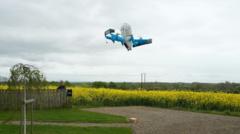
The tech press is swooning over a plastic quadcopter dropping a package in a Cambridgeshire field. They call it the dawn of a logistics revolution. They are wrong. What you just witnessed wasn't the future of retail; it was an expensive, high-altitude theater production designed to distract you from the crumbling reality of unit economics.
Amazon’s "Prime Air" isn't about getting you a toothbrush in thirteen minutes. It is a desperate attempt to solve the "last mile" problem using the most inefficient tool possible. I’ve spent years deconstructing supply chains, and the math on drone delivery doesn't just look bad—it looks impossible.
The industry is drunk on the novelty of flight. They’ve ignored the physics of weight, the reality of urban density, and the nightmare of British weather. If you think a fleet of buzzing bees is going to replace the humble, diesel-chugging white van, you haven’t been paying attention to the balance sheet.
The Weight Problem That Nobody Mentions
The "lazy consensus" suggests that because drones move fast, they are efficient. This ignores the brutal reality of the lift-to-drag ratio.
To carry a 2kg package, a drone must spend a massive amount of energy just to keep itself and its battery in the air. A delivery van, while "slow" in traffic, carries two tons of cargo using a tiny fraction of the energy per gram. When a van makes a stop, it drops off one of a hundred packages. When a drone makes a delivery, it has to return to base to recharge.
It is a 1-to-1 ratio in a world that demands 1-to-Many.
In logistics, we talk about "drop density." A high-density route is where a driver parks once and hits five houses. Drone delivery, by its very nature, destroys drop density. You are sending a dedicated aircraft for a single bottle of vitamins. It’s not innovation; it’s an ego-driven logistical regression.
The Sky is Already Full
Everyone asks, "When will the sky be full of drones?" The answer is: Never.
The UK Civil Aviation Authority (CAA) isn't going to let thousands of autonomous blades spin over primary schools just so someone can get a USB-C cable slightly faster. The regulatory hurdle isn't a "speed bump"—it’s a concrete wall.
Current flight regulations require "Beyond Visual Line of Sight" (BVLOS) capabilities that are still in their infancy. Even with perfect tech, the noise pollution alone would trigger a populist revolt. Imagine the sound of ten thousand angry hornets over a London suburb at 7:00 AM. Local councils can barely agree on bike lanes; they aren't going to green-light a permanent acoustic nightmare.
The Rural Trap
Amazon’s UK trial took place in the countryside. There’s a reason for that. Drones love flat fields and houses with massive gardens.
But where is the money? It’s in the cities.
Try delivering a package via drone to a fourth-floor flat in Hackney. Where does it land? On the balcony? In the middle of the street where a passerby can snag it? Through a window? The moment you move from a sprawling Cambridgeshire estate to a high-density urban environment, the drone becomes a liability.
If your technology only works for people with half-acre lawns, you haven't built a delivery service. You've built a toy for the landed gentry.
The Weather Reality Check
The UK is not Southern California. It rains. It blows. It stays grey for six months of the year.
Most commercial delivery drones are grounded the moment wind speeds hit 20 knots or moisture levels rise. In the UK, that’s about 40% of the year. A logistics network that only works on sunny Tuesdays isn't a network; it's an intermittent hobby. Amazon is promising "Prime" reliability with a vehicle that is scared of a stiff breeze.
I’ve seen companies burn through nine-figure VC rounds trying to "disrupt" physics. You can’t optimize your way out of a gale-force wind.
The Real Cost of "Free" Shipping
Let’s talk about the hidden overhead. To run a drone fleet, you don’t just need drones. You need:
- Certified Remote Pilots: Even "autonomous" fleets require human oversight by law. These aren't minimum-wage warehouse workers; these are specialized technicians.
- Maintenance Hubs: Drones are fragile. They crash. They need blade replacements and battery cycles. The "per-mile" maintenance cost of a drone is roughly 15 times higher than a Mercedes Sprinter.
- Insurance: The liability of a 20kg object falling from 400 feet onto a Tesla or, worse, a pedestrian, is a premium nightmare.
When you add these up, that "thirteen-minute delivery" costs Amazon roughly £30 to £50 per package. They are charging you nothing for it. This isn't a business model; it’s a customer acquisition cost that would make a Silicon Valley burning-man weep.
What You Should Be Watching Instead
While you’re looking at the sky, the real disruption is happening on the pavement.
Sidewalk delivery robots—small, slow, six-wheeled coolers—actually make sense. They don't fight gravity. They don't fall out of the sky. They use a fraction of the power and can wait patiently outside a flat for a pin code. They are boring, ugly, and effective.
But "boring and effective" doesn't get a segment on the evening news. "Flying robots" does.
Stop Asking "When" and Start Asking "Why"
People keep asking, "When will I get my first drone delivery?"
The better question is: "Why would I want this?"
We have been conditioned to believe that "faster is better" at any cost. But the cost here is privacy, quiet skies, and a massive waste of electrical energy. We are solving a problem—waiting two days for a package—that wasn't actually a problem.
Amazon knows this. They know the drones won't scale. But as long as the public and the shareholders believe they are "the most innovative company on earth," the stock price stays buoyant. The drone is a marketing asset, not a logistics asset.
If you want to invest in the future of delivery, look at the companies fixing the boring stuff: route optimization software, high-capacity electric vans, and local micro-fulfillment centers.
The future is grounded. It’s dirty. It’s efficient. And it definitely doesn't have propellers.
Stop looking up. The revolution is happening at street level.