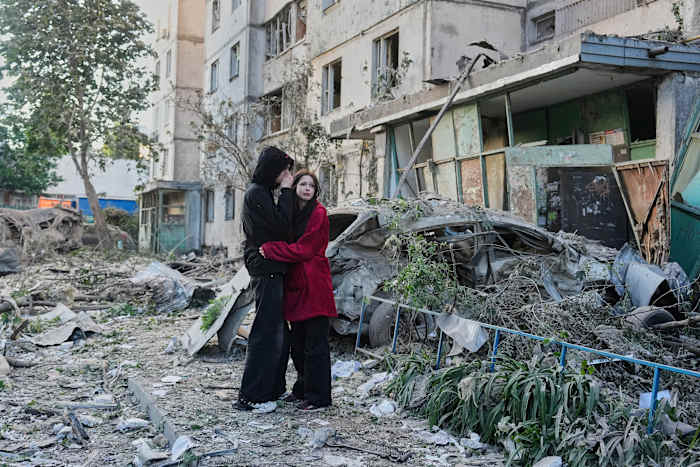
Sirens don't offer much comfort anymore. When Russia unleashed its latest overnight barrage of missiles and killer drones across Ukraine on Tuesday, the alerts screamed for hours. By dawn, at least 11 people were dead, dozens lay injured, and rescue crews were frantically digging through smoking concrete to reach civilians trapped inside crumbling high-rises.
This isn't a new story, but it's getting progressively more lethal.
The strategy behind these coordinated strikes is clear. Russia is intentionally combining cheap Shahed drones with complex ballistic and cruise missiles to overwhelm Ukrainian air defense systems. While mobile teams can shoot down the slow-moving drones with truck-mounted machine guns, the ballistic missiles are cutting right through the net. If you want to understand why Ukraine is aggressively demanding more Western hardware, look no further than the uneven state of its sky defenses.
The Reality of the Mixed Barrage Strategy
Kyiv braced for this hit for days. President Volodymyr Zelenskyy had already warned the country that a massive assault was brewing. When it arrived, the sheer volume of weapons shattered the night.
In Kyiv alone, falling debris and direct impacts damaged residential buildings across eight different districts. The State Emergency Service of Ukraine confirmed that at least four people died in the capital, with 58 others injured, including three children. The physical damage highlights a massive tactical issue. In the high-end Solomianskyi district, a 20-story building and a neighboring 24-story tower were severely punctured. Meanwhile, in the older Podilskyi district, the top floors of a nine-story apartment block collapsed, burying residents under tons of brick and insulation.
But Kyiv wasn't the only target. The central region of Dnipropetrovsk took an even heavier beating.
Strikes on the city of Dnipro killed at least six people and injured 36. Worse, the tactics turned explicitly cruel. A second strike hit the exact same location just as first responders arrived, killing a rescue worker on the spot. It's a brutal Russian military tactic known as a "double-tap," designed specifically to maximize casualties among emergency personnel. A two-story home was flattened, and a four-story apartment block was partially pancaked, leaving search teams working under the constant threat of secondary collapses.
The Blind Spot in Ukraine's Shield
There's a common misconception that because Ukraine routinely announces high interception rates—sometimes knocking down 80% to 90% of incoming targets—the sky is mostly protected. That's a dangerous misunderstanding of the data.
Air defense isn't a one-size-fits-all system. It operates in layers.
- Low-tier defense: Mobile air-defense units utilizing Gephard anti-aircraft guns or shoulder-fired missiles are highly effective against slow, low-flying loitering munitions like the Iranian-designed Shahed drones.
- Medium-tier defense: Systems like NASAMS or IRIS-T handle cruise missiles quite well, tracking their predictable, airplane-like flight paths.
- High-tier defense: Only rare, expensive systems like the American-made Patriot or the European SAMP/T can intercept ballistic missiles.
When Russia throws a massive wave of drones at a city, they aren't just trying to hit targets; they're trying to drain ammunition and force radar systems to turn on. Once the defense positions are mapped or distracted, Russia fires supersonic ballistic missiles like the Iskander-M or Kinzhal.
These weapons travel at hypersonic speeds and drop from extreme altitudes. Ukraine simply doesn't have enough high-tier batteries to protect every major city, let alone the front lines. When a ballistic missile targets Dnipro or Kharkiv, local teams often lack the specific interceptors needed to stop it. The result is what we saw on Tuesday: catastrophic structural failure in dense civilian zones.
The Sanctions Evasion Reality
You might wonder how Russia keeps producing these sophisticated weapons years into an aggressive global sanctions regime. The answer is frustratingly simple: the global supply chain is incredibly leaky.
Recent wreckage analysis conducted by Ukrainian military experts on recovered cruise missile fragments revealed components manufactured just months, or sometimes weeks, prior to the launch. Western microelectronics, commercial chips, and dual-use machine tools continue to flow into Russian factories through third-party distributors based in countries that haven't signed on to the sanctions.
This isn't an abstract economic problem. Every failed sanction or unblocked shipping loophole translates directly into a missile that punches through a kitchen ceiling in Kyiv. The Western alliance can't just send more interceptors; it has to actively choke the supply lines that allow these weapons to be built in the first place.
Moving Beyond Emergency Response
Shoveling through rubble after the fact is a losing strategy. The human toll is mounting, and emergency workers are running on fumes. To shift the dynamic, Ukraine's partners need to move past reactive aid packages.
First, the immediate priority must be the provision of dedicated anti-ballistic missile systems. Sending more short-range drone killers helps protect power plants, but it won't stop a nine-story apartment building from being cut in half. Second, Western nations must enforce secondary sanctions on the front companies facilitating the trade of microchips into Russia.
Until the structural gaps in the air defense network are closed, residential neighborhoods will keep bearing the brunt of the war. If you want to keep track of how these defense needs are developing on the ground, follow updates directly from the State Emergency Service of Ukraine Telegram channel or monitor independent security analysts tracking military logistics. The sky over Ukraine is still very much a open front line.