In May 2016, a movie arrived in theaters with the kind of pedigree that usually suggests a license to print money. It had Ryan Gosling, then a white-hot commodity of indie cool and leading-man charm. It had Russell Crowe, an Oscar-winning titan of gravitas. It was written and directed by Shane Black, the man who practically invented the modern buddy-cop genre with Lethal Weapon and had just come off directing a billion-dollar Marvel hit.
The critics loved it. The reviews were glowing. The premiere at Cannes ended with a standing ovation.
Then it hit the American box office and sank like a stone.
Opening against the second weekend of Captain America: Civil War and the debut of The Angry Birds Movie, The Nice Guys eked out a miserable $11 million in its first three days. By the time it finished its theatrical run, it hadn't even made back its $50 million production budget in the States. For the accountants at Warner Bros., it was a failure. For the industry, it was a eulogy for the mid-budget, original R-rated comedy.
But something strange happened on the way to the bargain bin.
A decade later, you can’t walk through a film festival or scroll through a cinema forum without hearing someone mention Holland March or Jackson Healy. The film didn't just find an audience; it became a personality trait for a specific brand of movie lover. It didn't just survive; it evolved into a digital ghost that haunts every "underrated" list on the internet.
The Chemistry of Chaos
To understand why a ten-year-old flop is currently more relevant than half the movies that actually made money in 2016, you have to look at the peculiar, combustible energy between its two leads.
Picture a hypothetical viewer named Sarah. She’s tired of "the formula." She’s seen twenty superhero movies where the world is at stake, and she’s numb to the spectacle. She puts on The Nice Guys on a rainy Tuesday night because she heard a clip of Ryan Gosling screaming like a wounded bird in a bathroom stall.
Within twenty minutes, she’s not watching "stars." She’s watching a car crash of human incompetence.
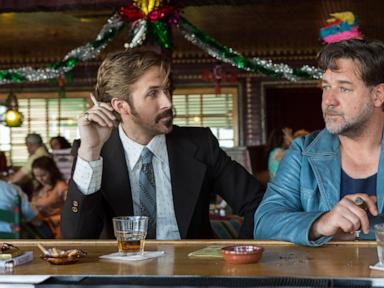
Ryan Gosling’s Holland March is a bottom-feeding private eye who is, quite frankly, a terrible father and a functional alcoholic. Russell Crowe’s Jackson Healy is a hired thug who breaks arms for a living and worries he has no purpose. They are not heroes. They aren't even particularly good at their jobs.
There is a moment early in the film where March tries to break a window with his fist to enter a building. Instead of the glass shattering heroically, he slices his arm open, nearly bleeds to death, and has to be rushed to the hospital while wailing in genuine terror.
It is pathetic. It is hilarious. It is deeply, painfully human.
We spent the 2010s being fed a diet of hyper-competent protagonists. We had geniuses, billionaires, and super-soldiers. The Nice Guys gave us two guys who struggle to find a door handle. That vulnerability is the hook. We see ourselves not in the victory, but in the frantic, messy scramble to just survive the day.
A Ghost Town of Neon and Smog
The film is set in 1977 Los Angeles, a city choked by smog and moral decay. Shane Black didn't treat the seventies as a kitschy costume party. He treated it as a fever dream.
The plot involves a missing girl, a dead porn star, and a conspiracy involving the automotive industry. It’s "noir," but it’s noir seen through the bottom of a cracked whiskey glass.
Consider the "invisible stakes." On the surface, the movie is a mystery. But the emotional core is about two men who have been discarded by society trying to prove they still matter. Healy wants to be a protector in a world that only wants him to be a fist. March wants to be a hero in the eyes of his daughter, Holly, who is arguably the only actual adult in the room.
Angourie Rice, who played Holly, provided the moral compass that the genre usually ignores. She isn't a prop; she’s the witness. Her presence forces the audience to acknowledge the absurdity of the violence. When she looks at her father with a mix of love and profound disappointment, the movie moves from a simple comedy to a tragicomedy about the failure of the American Dream.
The industry didn't know how to sell that. How do you market a movie that is simultaneously a slapstick riot and a cynical critique of corporate corruption? You don't. You put a colorful poster out, hope for the best, and watch it get crushed by a giant purple space titan or a flock of animated birds.
The Digital Resurrection
The "cult" of The Nice Guys is a byproduct of the streaming era’s greatest strength: the second chance.
In the old world, a theatrical flop died in the "Pre-Owned" section of a Blockbuster. Today, an algorithm notices that people who liked Kiss Kiss Bang Bang or The Big Lebowski also tend to linger on this movie with the two famous guys on the cover.
Word of mouth changed. It stopped being about what was "new" and started being about what was "discovered."
There is a specific joy in finding a masterpiece that the world initially rejected. It feels like a secret. When you show The Nice Guys to a friend today, you aren't just sharing a movie; you’re performing an act of cinematic justice. You’re saying, "The system was wrong about this one."
The facts of its revival are measurable. Look at the Letterboxd stats. Look at the memes of Gosling’s high-pitched panic that circulate on TikTok and X every time someone mentions "peak cinema." The film has a higher "re-watchability" factor than almost any other movie from its decade because the dialogue is so dense with jokes that you physically cannot catch them all in one sitting.
"Don't say 'and stuff,'" March tells his daughter. "Just say, 'They were eating.' You sound like a dipshit."
It’s a throwaway line, but it’s delivered with such earnest, misplaced parental authority that it sticks. The movie is a mosaic of these tiny, perfect character beats.
The Industry That Forgot How to Laugh at Itself
The enduring legacy of The Nice Guys is also a somber reminder of what we’ve lost.
In the current theatrical environment, a movie like this would likely never be made for the big screen. It would be shuffled off to a streaming service where it would disappear into a "content rail" after two weeks.
We are living through a period of "safe" filmmaking. Studios want intellectual property. They want sequels. They want a guaranteed return on investment. The Nice Guys was a risk. It was an original script based on nothing but the strength of its writing and the charisma of its stars.
The fact that it failed financially in 2016 gave studios the excuse they needed to stop trying.
But the fans haven't stopped trying. Every year, like clockwork, a rumor starts on social media that a sequel is in development. "Nice Guys 2" trends for twelve hours. People start casting ideas. They want to see March and Healy in the eighties. They want to see them fail at solving a crime in the era of neon spandex and cocaine.
It hasn't happened. It probably won't happen.
But that’s part of the cult’s power. The movie exists in a vacuum of perfection. It is a single, flawless lightning strike. It didn't get a bloated franchise that diluted its charm. It stayed pure.
The real mystery of The Nice Guys isn't who killed Misty Mountains or what’s in the mysterious film reel. The mystery is how we, as an audience, let something this good slip through our fingers the first time around.
We were looking for heroes who could fly. We forgot to look for the guys who fall off a roof, land on a tree, and apologize to the birds on the way down.
Ten years on, the smog in Los Angeles has cleared, but the world feels a little more corporate, a little more polished, and a lot less funny. We keep going back to Holland March and Jackson Healy because they represent a type of storytelling that doesn't care about being "important." It only cares about being true.
It turns out that being a "nice guy" wasn't about winning. It was about showing up, getting your arm broken, and having the decency to feel embarrassed about it.
And in a world of manufactured perfection, there is nothing more magnetic than a beautifully executed disaster.