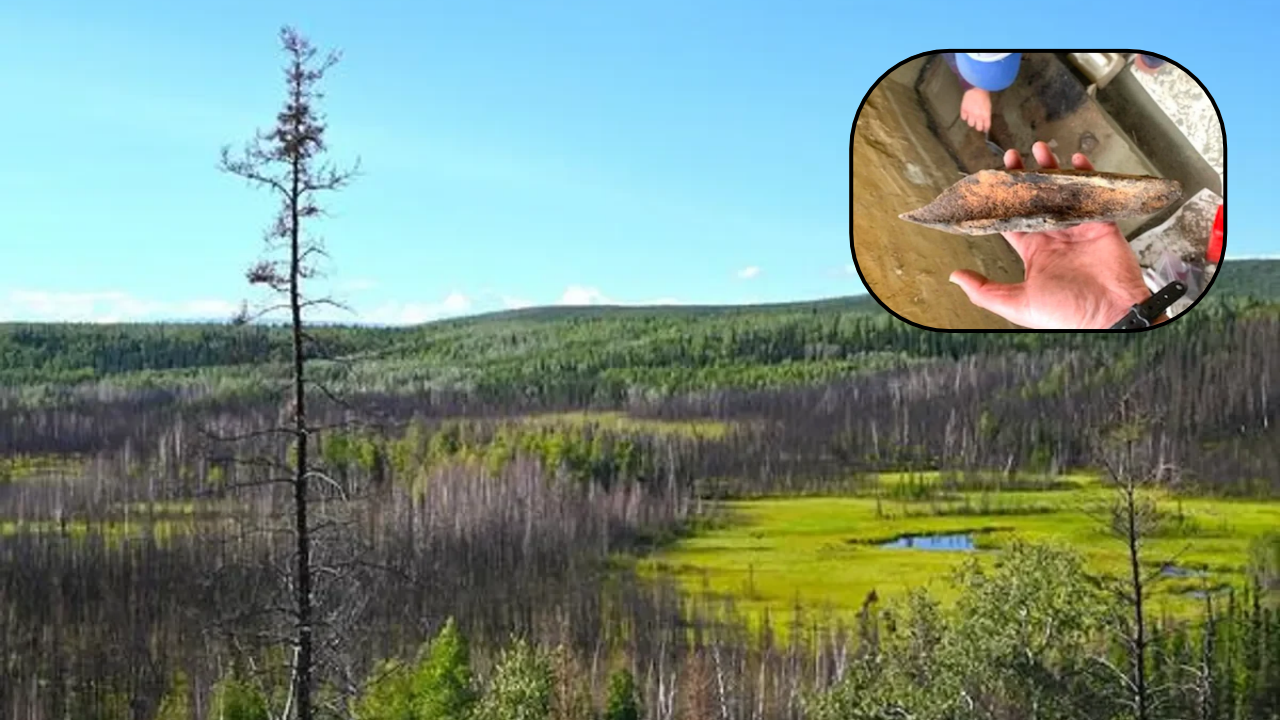
Buried beneath layers of windblown glacial silt in central Alaska’s Tanana Valley, a 13,800-year-old campsite is forcing archaeologists to rewrite the timeline of human survival in the subarctic. At sites like Swan Point and Holzman, excavations have uncovered stone microblades, ochre-stained hide-working tools, butchered waterfowl bones, and well-preserved hearths dating to the terminal Pleistocene. These findings demonstrate that early Beringian populations did not merely pass through an icy corridor on their way south. They settled, adapted, and built complex seasonal economies in interior Alaska nearly fourteen millennia ago.
For decades, the dominant narrative of the peopling of the Americas relied on a neat, linear migration model. Small bands of big-game hunters supposedly crossed the Bering Land Bridge, sprinted south through an ice-free corridor between the Laurentide and Cordilleran ice sheets, and rapidly populated the continents. That story was always too clean. Real human migration rarely looks like an arrow drawn on a textbook map.
The Myth of the Passing Migrant
When you look closely at the dirt in the Tanana Valley, the "passing through" theory falls apart immediately. People do not haul heavy stone cores, manufacture specialized composite weapons, and establish recurring seasonal camps if they are just rushing toward warmer latitudes.
The 13,800-year-old Alaska campsite evidence points to deliberate, long-term residency in eastern Beringia. Consider what it takes to keep a fire burning and a family fed during a late Pleistocene spring in interior Alaska. The climate was warming out of the Last Glacial Maximum, transforming the dry, windy mammoth steppe into a patchwork of scrub tundra, wetlands, and emerging river systems.
Archaeologists working in the Shaw Creek basin—a region dense with terminal Pleistocene sites—have found distinct activity zones around ancient hearths. In one area, stone knappers struck razor-sharp microblades from wedge-shaped cores. Inches away, someone processed hides using red ochre, a mineral pigment prized both for its preservative qualities in tanning leather and its symbolic weight.
This is domestic infrastructure. It reflects a community that knew the local geography intimately, understood seasonal animal migrations, and possessed the technological flexibility to exploit whatever resources the changing environment offered.
Why Microblades Changed Everything
To understand how humans survived at the edge of the Arctic Circle 13,800 years ago, you have to look at their toolkit. Traditional Clovis sites farther south are famous for large, fluted spear points designed for taking down megafauna like mammoth and mastodon. Interior Alaska tells a different story.
Early Beringians relied heavily on microblade technology. Instead of knapping a single massive stone point—which is heavy, brittle, and consumes huge amounts of high-quality rock—toolmakers produced tiny, standardized stone blades, often less than an inch long. These blades were slotted into grooves carved along the sides of bone or antler shafts, creating a composite weapon with a continuous cutting edge.
The engineering logic is ruthless and brilliant.
- Material efficiency: A fist-sized cobble of chert or obsidian could yield dozens of microblades, drastically reducing the burden of carrying raw stone across rugged terrain.
- Field repair: If a projectile shattered against bone during a hunt, the hunter did not need to throw away the entire weapon. They simply pried out the damaged stone insert and glued in a fresh microblade using heated birch-bark pitch or conifer resin.
- Versatility: The same microblade cores produced inserts for hunting darts, carving knives, and skinning tools.
This technological system originated in Northeast Asia and crossed Beringia with the ancestors of Native Americans. Finding intact microblade workshops beside hearths in 13,800-year-old Alaskan camps proves that these populations were not improvising in a hostile wilderness. They brought a refined, cold-weather industrial system with them and tuned it to the Alaskan interior.
Rethinking the Pleistocene Diet
Pop culture loves the image of Ice Age hunters exclusively chasing woolly mammoths across frozen plains. The reality dug out of Alaskan hearths is far more pragmatic, and frankly, much smarter.
While early Beringians certainly hunted large mammals—bison, wapiti, and occasionally mammoth, whose ivory was harvested for tools—their survival hinged on broad-spectrum foraging. Excavations at contemporaneous Tanana Valley sites have recovered the charred remains of ducks, swans, geese, hares, and fish alongside large mammal bones.
Waterfowl were a particularly vital seasonal windfall. Migratory birds arriving in the spring offered dense protein and fat at the exact moment winter food stores ran thin. The presence of bird bones around 13,800-year-old hearths confirms that these campsites were occupied during specific, calculated windows of the year. Hunters timed their movements to intercept migrating flocks in the wetlands of the Shaw Creek flats, turning seasonal abundance into storable calories.
The Preservation Problem in Subarctic Archaeology
If people were living across eastern Beringia 13,800 years ago, why are these campsites so rare? The answer has less to do with ancient population size and more to do with brutal geology.
Interior Alaska escaped the massive continental ice sheets that buried Canada, which is why it remained habitable. However, the region was subjected to relentless aeolian deposition—thick blankets of windblown loess picked up from glacial riverbeds. Over thousands of years, this fine dust buried ancient campsites under meters of sediment.
On top of that, centuries of freezing and thawing—a process called cryoturbation—churn the soil like slow-motion taffy. Frost heaving can scramble stone tools and charcoal layers, mixing artifacts from different millennia and destroying the spatial layout of a camp.
Finding an undisturbed hearth from 13,800 years ago requires a rare geological miracle. The campsite must be buried quickly enough by gentle windblown silt to seal the charcoal and bone away from scavengers and acidic forest soils, yet remain just above the active permafrost zone where ice wedges would tear it apart. When researchers uncover an intact hearth with charcoal that can be radiocarbon-dated alongside stone tools, they are looking at a needle pulled from a continental haystack.
The Coastal Route Versus the Interior Corridor
Every new discovery in interior Alaska feeds directly into one of the fiercest debates in modern archaeology: how did the first humans actually reach the Americas south of the ice sheets?
For years, the Ice-Free Corridor hypothesis reigned supreme. Geologists noted that as the massive Laurentide and Cordilleran glaciers began to melt, a narrow pathway opened up east of the Canadian Rockies, funneling migrants from Alaska straight into the Great Plains.
The problem is timing. Recent core samples and ancient DNA studies of lake sediments suggest that the Ice-Free Corridor did not become biologically viable—meaning it lacked enough vegetation and game to keep humans alive—until roughly 12,600 years ago. Yet archaeological sites in Chile, Oregon, and Texas show humans living well south of the ice sheets by at least 14,500 years ago.
This chronological clash propelled the Pacific Coastal Route into the spotlight. Under this model, early seafaring or shoreline-foraging groups moved down the Pacific coast from Beringia, hopping between ice-free refugia and living off kelp forests rich in shellfish, seals, and fish.
Where does a 13,800-year-old campsite in central Alaska fit into this rivalry? It demonstrates that eastern Beringia was not an empty waiting room. While coastal pioneers may have pushed south along the shoreline centuries earlier, substantial populations remained rooted in the Alaskan interior. They thrived in the river valleys, maintaining cultural and genetic ties across the Beringian landmass long after rising sea levels began drowning the land bridge itself.
What the Hearths Tell Us About Social Life
Charcoal is more than a clock for radiocarbon dating. To an archaeologist, a hearth is the social gravity well of an ancient camp.
In the freezing temperatures of late Pleistocene Alaska, fire was survival, light, and community rolled into one. By mapping the exact coordinates of every microscopic stone flake—a technique called piece-plotting—researchers can reconstruct where people sat around these 13,800-year-old fires.
The spatial patterns tell an intimate story. A dense cluster of tiny microblade debitage on the upwind side of a hearth shows where an experienced toolmaker sat, letting the breeze carry away microscopic glass-like dust while crafting weapons. Across the fire, a scatter of end-scrapers and red ochre dust marks the workspace where hides were cleaned, softened, and waterproofed for tailored parkas and boots.
Without tailored, multi-layered skin clothing, human survival in interior Alaska during the Younger Dryas cold snap would have been physically impossible. The bone needles and hide scrapers recovered near these hearths are the silent proof of sophisticated textile engineering. Every seam had to be watertight; every boot sole had to insulate against frozen ground.
The Missing Pieces of the Beringian Puzzle
Despite the breakthroughs in the Tanana Valley, huge blind spots remain. The biggest one sits underwater.
At the peak of the last ice age, global sea levels were roughly 400 feet lower than today, exposing a subcontinent-sized stretch of land connecting Siberia and Alaska. Beringia was not a narrow causeway; it was a massive, rolling plain stretching nearly a thousand miles north to south.
Most of the people who lived in Beringia likely inhabited the low-lying river valleys and coastal plains of that central landmass. Today, the Bering and Chukchi seas cover their campsites under hundreds of feet of freezing water.
Archaeologists working in interior Alaska are essentially studying the eastern highlands of a lost world. They are piecing together the history of an entire civilization from the communities that lived along its upland margins. Every intact hearth, every microblade core, and every butchered waterfowl bone recovered from the Alaskan silt is a fragment of a much larger human footprint—one that proves the first Americans were never mere wanderers, but masters of one of the harshest environments on Earth.