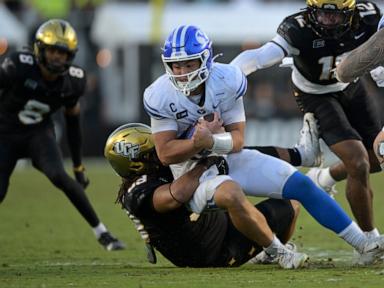
Silence.
That is the one thing an athletic director never buys, never markets, and never wants inside a stadium built for forty-five thousand screaming voices—yet on a Tuesday afternoon in Orlando, a quiet administrative memo did what three hundred pounds of opposing offensive line never could, flattening the swagger of an entire football program with a six-figure invoice and a public reprimand.
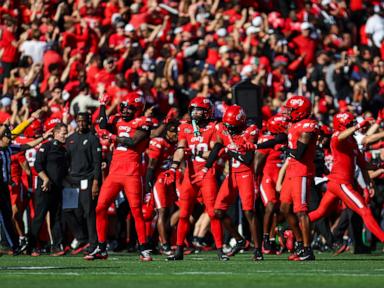
To understand what happened when the Big 12 Conference fined the University of Central Florida $100,000 for fan behavior aimed at Brigham Young University and the Church of Jesus Christ of Latter-day Saints, you first have to stand inside FBC Mortgage Stadium on a humid Florida Saturday. Locals call it the Bounce House. When the student section starts jumping in unison to Zombie Nation, the steel bleachers physically flex beneath your sneakers, vibrating up through your shins into your ribcage until your own heartbeat loses the argument and syncs with the crowd. It is intoxicating. You feel invincible inside a roar that loud, anonymous inside a sea of black and gold, absolved of individual weight because forty thousand strangers are carrying the noise right beside you.
That anonymity is the oldest drug in sports.
For decades, college athletics treated stadium hostility like weather—unpleasant for visitors, occasionally embarrassing on a hot television microphone, but ultimately part of the home-field climate you simply endured. Coaches praised hostile environments in Monday press conferences. Athletic departments sold T-shirts bragging about how hard it was to play in their building. The unspoken contract of the modern college stadium was simple: buy a ticket, stay off the playing surface, refrain from throwing batteries or bottles, and whatever leaves your throat belongs to the wind.
Except the wind doesn't just carry sound anymore. It carries liability.
When the Crowd Becomes the Defendant
Picture a fictional eighteen-year-old freshman named Caleb standing in row fourteen of the UCF student section during the third quarter against BYU. Let's be clear: Caleb is a composite, a hypothetical kid in an oversized jersey sweating through the central Florida humidity, holding a lukewarm soda and losing his voice. He isn't a villain plotting a hate-crime manifesto in his dorm room. He is a teenager caught in the gravitational pull of tribal mockery, repeating a chant that started three rows down because everyone around him is laughing, filming on their phones, and riding the adrenaline of a Big 12 matchup.
When the chant turns from standard trash talk about missed tackles or blown coverages into targeted derision aimed at BYU's religious identity and the Mormon faith, Caleb doesn't pause to consult the Big 12 Conference Handbook on Sportsmanship and Ethical Conduct. Nobody does in row fourteen. In the heat of a stadium, the boundary between clever heckling and religious bigotry blurs so fast that half the people yelling don't even recognize the line until they are twenty yards past it.
Now shift your vantage point fifty yards up and two hundred yards away, to a climate-controlled suite or a television monitor in Irving, Texas, where Big 12 Commissioner Brett Yormark and conference officials review the game tape and post-game reports.
From that distance, there is no adrenaline. There is no humid air, no vibrating aluminum, no contagious laughter from the guy next to you. There is only clear audio, documented witness accounts, and a conference rulebook that explicitly prohibits abusive, discriminatory, or derogatory conduct targeting race, religion, national origin, gender, or sexual orientation.
The resulting punishment—a $100,000 fine accompanied by a formal public reprimand—landed with the dull, heavy thud of a gavel. UCF accepted the penalty without an appeal, issuing the kind of carefully scrubbed institutional apology that athletic departments keep pre-written in a desk drawer for emergencies: remorseful, firm on core values, vague on operational mechanics.
To a casual observer scrolling past the headline, $100,000 sounds like couch-cushion money for a Power Four athletic department swimming in television revenue. That assumption misses the entire architecture of modern college sports.
The Invisible Math of a Six-Figure Fine
Let's strip away the abstraction of six zeros and look at what $100,000 actually represents inside an athletic department budget—especially one like UCF's, which jumped from the American Athletic Conference into the Big 12 in 2023 and has been scrambling ever since to build Power Four infrastructure on a transitional revenue share.
A hundred thousand dollars is two full-ride athletic scholarships for out-of-state Olympic sport athletes. It is an entire season's travel budget for a women's rowing or cross-country squad. It is the annual salary of two entry-level academic advisors who sit with nineteen-year-old players at seven in the morning to make sure they pass organic chemistry. When a conference levies a fine of that magnitude, the money doesn't evaporate out of an imaginary slush fund labeled "fan misbehavior." It is deducted directly from conference distributions—money the university had already allocated to pay bills, service stadium debt, or fund non-revenue teams fighting to survive in the era of House v. NCAA revenue sharing.
Think of a university's relationship with its conference like a co-signed mortgage between neighbors. You don't just own your own house; your property value, your insurance rates, and your standing in the neighborhood depend on nobody setting fireworks off in the cul-de-sac. When BYU entered the Big 12 alongside UCF, Cincinnati, and Houston in the summer of 2023, the conference didn't merely add four football helmets to a television graphic. It merged wildly different regional cultures, religious traditions, and fan vocabularies into a single commercial enterprise.
Suddenly, a public research university in Orlando—born in the Space Age, built on commuter-school grit and rebellious "Citronaut" humor—was sharing a balance sheet with the flagship educational institution of the Church of Jesus Christ of Latter-day Saints in Provo, Utah.
And BYU brought a very specific, well-documented history into the room.
A Pattern That Preceded Orlando
If you have followed college athletics closely over the past decade, the UCF fine does not read like an isolated freak accident. It reads like the latest chapter in a recurring collision between secular stadium culture and religious identity.
Long before BYU joined the Big 12, visiting games in the Pac-12, the Mountain West, and the West Coast Conference routinely produced flashpoints. In 2021, Oregon fans chanted an explicit, derogatory slogan aimed at Mormons during a game in Eugene, forcing the University of Oregon and its student government to issue public apologies. Similar incidents flared at USC, at Providence, at basketball arenas where students sit close enough to the baseline that players can smell the peppermint on their breath. Each time, the script played out identically: shock from visitors, defensiveness from locals claiming "it was just a few drunk kids," a stern statement from a university president, and zero structural change before the next kickoff.
Why does this keep happening specifically around BYU?
Partly because religious identity occupies a strange blind spot in American sports trash talk. Fans have internalized—mostly through sheer repetition and heavy-handed security enforcement—that racial slurs or homophobic chants will get you ejected, banned, and plastered across social media before halftime. Yet religious mockery still gets treated in many dorm rooms and tailgates as fair game, lumped lazily into the same category as teasing an opponent about their mascot, their weather, or their academic rankings. People tell themselves they are mocking an institution, not a person, forgetting that for the eighteen-year-old Mormon kid trying to catch a slant route in the fourth quarter, his faith isn't an abstract corporate brand on his helmet. It is the spine of his entire life.
I have sat in press boxes and stadium bowls long enough to recognize the exact second a crowd tips from fierce to ugly. You can hear it in the pitch of the noise. Good stadium heat is low, guttural, and rhythmic—it rises and falls with the snap of the ball, tethered to the game. Ugly crowd noise has a sharp, giddy edge to it. It feeds on itself rather than the scoreboard. People start looking around at their friends for validation instead of watching the quarterback, thrilled by the small transgression of saying something out loud in a crowd that they would never whisper to a stranger's face in a grocery store.
That distinction—between targeting a team's performance and targeting a person's protected identity—is the entire legal and moral foundation of the Big 12's intervention.
Why the Conference Drew the Line Here
To understand why Brett Yormark moved so decisively, you have to understand the business vulnerability of a newly expanded sixteen-team conference stretching from Orlando to Salt Lake City and from Tucson to Morgantown.
Television networks do not pay hundreds of millions of dollars a year for prime-time windows so that their broadcast microphones accidentally pipe religious slurs into five million living rooms on a Saturday afternoon. Corporate sponsors—the banks, airlines, and insurance companies whose logos wrap the LED ribbon boards around the Bounce House—do not write seven-figure checks to be associated with viral clips of sectarian abuse.
In a hyper-fragmented media landscape, one ten-second smartphone video recorded from row fourteen can hijack a Monday news cycle, trigger sponsor inquiries, and turn a competitive conference game into a reputational crisis. The Big 12 couldn't afford to treat UCF's incident as a harmless college prank because doing so would have signaled to every other student section in the league—from Lubbock to Ames to Stillwater—that BYU was open season.
By slapping a $100,000 price tag on the behavior, the league translated a fuzzy moral expectation into hard currency. It forced every athletic director in the conference to look at their stadium security budget, their alcohol sales policies, and their student-section messaging not as public-relations fluff, but as direct risk management.
Still, if we are being completely honest with ourselves, there is something deeply unsettling about how this mechanism works.
The Uncomfortable Paradox of Collective Punishment
Pause and ask the question every UCF season-ticket holder muttered over breakfast the morning the fine was announced: How is an athletic department supposed to police forty-five thousand mouths in real time?
It is a fair question, and pretending there is an easy answer insults everyone's intelligence. You cannot station a compliance officer behind every seat in the upper deck. You cannot gag a crowd before a chant starts, and once two thousand voices lock onto three syllables in unison, blowing a whistle or flashing a polite "Be Respectful" graphic on the jumbotron often pours gasoline on the fire rather than putting it out. College students, by evolutionary design, treat authoritative scolding from a PA announcer like a dare.
When the Big 12 fines UCF $100,000, the people who actually started the chant pay precisely zero dollars. They keep their student tickets. They keep their anonymity. Meanwhile, the athletic department—which spent the week promoting the game, hosting visiting officials, and trying to build a respectable program—absorbs the financial bruise and the national headline.
That feels fundamentally unfair. And yet, in the ecosystem of live sports, collective institutional accountability is the only lever that actually moves behavior.
Think of it like a restaurant's health inspection score. If a line cook forgets to wash his hands and makes a customer sick, the city doesn't fine the cook's personal checking account; it fines the restaurant and posts a "C" in the front window. Why? Because only the owner has the power to redesign the kitchen, retrain the staff, install better sinks, and change the culture inside the building.
Universities hold that exact same structural power over their stadiums, even if they rarely like to use it. They control who gets into the student section, how early alcohol is cut off, where plainclothes security officers stand, how quickly ushers revoke wristbands when a chant turns abusive, and whether student government leaders are brought into the room on Wednesday before a rivalry game instead of scolded on Tuesday after a fine.
When programs treat fan conduct as uncontrollable weather, nothing changes. When an athletic director suddenly has to explain to a university president why $100,000 just vanished from the bottom line, creative solutions materialize remarkably fast.
What Changes Before the Next Kickoff
Watch what happens quietly behind the scenes across the Big 12 over the next twelve months, long after the headlines fade and the news cycle moves on to coaching buyouts and transfer portal drama.
First, stadium operations teams stop relying on reactive complaints. Instead of waiting for a visiting athletic director to file a formal protest on Sunday morning, home security directors begin assigning dedicated audio and crowd-monitoring spotters specifically to the lower student sections during high-friction games. If a discriminatory chant sparks in section 112, ushers don't debate free speech philosophy; they immediately identify the instigators, confiscate their student IDs for the afternoon, and remove them within three minutes. Visible, immediate consequences inside the bowl break the illusion of anonymity faster than any post-game fine ever could.
Second, student leadership gets drafted into the solution. The best athletic departments—the ones that maintain electric, intimidating home-field advantages without crossing into bigotry—treat their student-section leaders like partners rather than suspects. Before high-profile matchups, coaches and administrators meet with the captains of the student cheering sections, level with them about what is at stake for the school's reputation and budget, and challenge them to keep the energy ferocious, creative, and aimed squarely at the game on the grass. Cleverness is always louder than cruelty anyway; any fan base that has to resort to attacking someone's religion has simply run out of wit.
Third, visiting programs and host schools start communicating explicitly before the plane even lands. When BYU travels to Orlando, Salt Lake City, or Morgantown, security directors share intelligence on known trouble spots, seating buffers near the visiting bench, and tunnel entrances, closing the physical gaps where intoxicated hecklers usually collide with players and families.
None of this requires sterilizing college football. Nobody wants a library in the Bounce House. College sports without passion, noise, tribal loyalty, and good-natured antagonism would be indistinguishable from an exhibition golf match. The roar is the whole point. The collective shiver when fifty thousand strangers hold their breath on a fourth-and-goal in November is one of the last genuinely communal experiences left in American public life.
That is precisely why the boundary matters so much. You protect the wildness of the stadium by refusing to let it rot into malice.
Picture that same stadium three hours after the final whistle on a Saturday night in Orlando. The floodlights have dimmed to maintenance mode, casting long, quiet shadows across the turf where thirty-six-inch sweat stains and torn blades of grass tell the physical story of four quarters. Down in the lower bowl, a grounds crew worker pushes a leaf blower methodically up row fourteen, clearing away crushed aluminum cans, discarded pom-poms, and peanut shells until the silver bleachers gleam empty under the Florida stars. Everything loud has gone home. Only the ledger remains.